Ultratremor
2026
Germano Dushá is a curator, writer, and cultural agent with a law degree (FGV Direito SP) and a postgraduate degree in Art: Criticism and Curatorship (PUC-SP). At the intersection of aesthetics, critical thinking, and esoteric traditions, his practice assumes multiple forms—as curatorial, literary, and hypermedia experiments—to investigate social imaginaries, and to dwell on the energy fluxes connected to radical subjective experiences and transmutation processes.
Contact germano@ofora.org
Brazil Mil Graus: Absolute Hot
We begin with the absolute heat, the primordial flame of the universe, the incandescent core that is the origin of everything. We begin with the total heat, under which time suspends and dilates, the wind yields, and even silence turns to embers. We begin with the indomitable heat, which makes each particle dance at the edge of thermal ecstasy; with the blaze of the fatal fire, after which everything transforms and burns into infinity.
The idea of an unsurpassable maximum temperature—in which molecular agitation would be so intense that all matter would disintegrate—is not practically and definitively applicable in physics. Or at least it is still beyond our analytical capacity. However, the German physicist Max Planck (1858–1947)—the father of quantum physics—proposed a temperature that would serve as a theoretical limit. The so-called “Planck temperature” (something like trillions of trillions of trillions of degrees Celsius) is believed to have been reached moments after the Big Bang, when the universe was still minuscule and dense. This temperature represents an energy regime so high that the laws of physics collapse, entering a completely new domain for our comprehension.
In the sacred words of the ancients, this essential fire appears as a force that transitions between creation and dissolution, echoing powers that transcend material understanding. In Hermes Trismegistus’ Corpus Hermeticum, fire is a dynamic symbol connected to the divine mind that shapes the universe. It is the emanation and body of the intellect that form and animate creation. In the Upanishads, fire is one of the primary elements born from the cosmic self. Associated with vital transformations, it embodies the energy that permeates the universe. It is also responsible for mediating between the earthly and the celestial and is central to spiritual purification rituals. In the Bhagavad Gita, Krishna reveals fire as the means by which the cosmic force manifests, burning within beings and sustaining life. Fire imagery also symbolizes complete transformation, with its consuming flame that engulfs multitudes, engendering endless cycles of death and rebirth, as the engine of eternal cosmic renewal.
Bringing the discussion to tangible grounds, the hottest temperature on Earth is found at the heart of volcanic eruptions. The liquid lava that bursts from the depths of the crust, pulsing like the planet’s burning blood, can exceed 1,000°C. At some indescribable point between solid and liquid, these streams of molten rock flow with fury. They are rivers of fire that shape reality in an act of ceaseless transformation, carrying within them the encounter between the distant past and the farthest future, gleaming as the earthly memory of a total time.
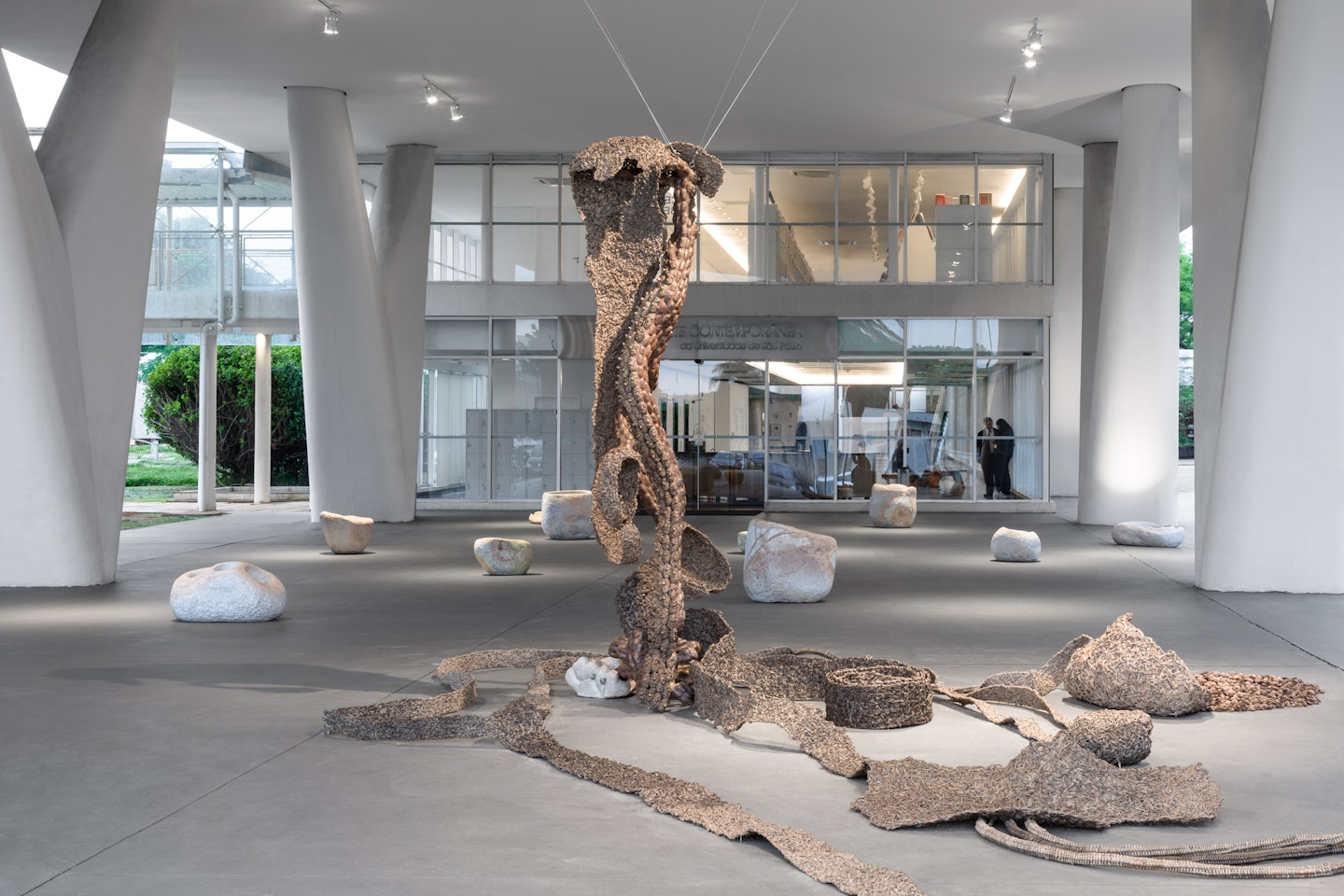
The notion of a “limit-heat” serves as a conceptual key for the 38th Panorama da Arte Brasileira [Panorama of Brazilian Art] to address phenomena with high energy charge and transmutation dynamics. As a science fiction, the idea of an “absolute heat” is activated to evoke extreme changes, which may relate to matter and physical bodies but also to subjective, social, political, and spiritual realms. Titled Mil graus (A Thousand Degrees), the exhibition celebrates an expression that energizes the streets, commonly used in some urban contexts in Brazil. This slang, which accurately encapsulates the curatorial foundation of the 38th Panorama—creating a striking image on the spot—carries a sharp ambiguity: depending on the context, it can indicate a high level of excellence or a situation of high intensity. Therefore, Mil graus is a flexible and expandable concept that can assume different senses, depending on its activation, but invariably refers to transformative experiences.
Under the vitality of this expression and its many meanings, the 38th Panorama brings forth multiple approaches and means of addressing the poetics of heat. The exhibition gathers a heterogeneous group of participants, including various generations, contexts, experiences, and perspectives. There are artists born in the 1940s and from various other generations up to the late 1990s and the 2000s. It also includes people from all regions of Brazil and from sixteen Brazilian states, with diverse research and practices connected to different cultural matrices. Thus, besides artists, the exhibition features other agents, such as a spiritual leader, a community, and a carnival group.
When discussing this thermal metamorphosis, representations and incorporations directly related to fire and heat, their visual aspects, chemical reactions, and physical processes immediately emerge. Similarly, it is unavoidable to consider wildfires and global warming. Given the current environmental catastrophe, which oppresses the present and casts a dense shadow on the future, this cannot be ignored. As this text is being written, Brazil has been hit by an epidemic of fires over the past few days, ending August with a staggering increase that has more than doubled the number of fire hotspots compared to the same period in 2023. Images of these wildfires overwhelm traditional news and social media, projecting a burning, feverish, and unstoppable apocalypse. The immediate effects of these blazes are visible in the skies of the country’s major cities, just as the intricate implications of the climate crisis are increasingly felt each day. However, by embracing high intensity and transmutation as focal points, the project works with a much broader spectrum of vital dynamics.
The exhibition articulates expanded ecological visions and notions that dismantle false dichotomies between humanity and nature. There are artists working with intersections and hybridizations, combining distinct elements to create new visualities and meanings from interspecies relationships and the blend between the organic and the artificial. Many works deal with material alteration, studying the action of time and other natural phenomena, and experimenting with manual processes. Others investigate—both as subject and medium—new materials, tools, and processes, incorporating industrial inputs and techniques, engaging with technologies, and navigating the digital sphere. These are ways to think of the human being and the anthropocentric mass as inseparable parts of the natural environment, reflecting on the interconnections between all living beings, and questioning the human condition itself in the face of the uncanny vastness surrounding us.
Overheat and body transformation also appear through various means, extrapolating physiology to discuss the politics of embodiment and the identities in mutation. Moving forward, we see works that reflect on the porosities between the individual and the collective, and the role of the subjective in cultural and political construction, especially during times of high pressure and social effervescence. In this context, the “limit-heat” symbolizes not only material changes but also the fervor of celebrations and struggles that shape our way of coexisting in the world. Finally, there are manifestations related to soul experiences, mystical symbolisms, and esoteric practices. Beyond sacred spaces and objects, this spirituality is in the telluric mysteries and the magic of the forest, and also in urban daily life, appearing whenever certain phenomena reach a high degree of ascension and allow for otherworldly access and points of contact between different dimensions.
Mil graus invokes science but also poetry and transcendence. It can prompt questions related to physical variations—concerning matter—but also to intangible and immaterial planes. Amidst the heterogeneity of languages and the rich contrasts between the participants of this Panorama, one can discern common points that traverse cultures, aesthetics, and formal solutions. There is an energy flowing, connecting the threads, always vibrating at high intensity, often escaping human apprehension.
Imagining a point of inflection in which heat reaches its maximum intensity implies shifting the human being from the center of the discussion, invoking a common ground that includes other forms of life and recognizes multiple agencies and purposes. Here, the core of the debate is not cultural but elemental. Instead of a limited anthropocentric view, space opens to broaden the understanding of ecological interactions, rethinking intrinsic connections with a multitude of agents, and thus, the place of the human being in the world. Furthermore, this imaginative exercise projects a reality that transcends the limits of the physical world as we know it, fostering radical questions and new understandings by confronting the unknown.
To discuss the Brazilian contemporary art scene from this point of view also underscores the vocation of this heated fiction we call “Brazil,” with its powers and contradictions. In the context of a “Panorama of Brazilian Art,” it can also refer to urgency, the heat of the moment, the “scorching” of the time, or something that is at its peak and demands immediate attention, something that is sizzling. However, as a panoramic overview, the curatorial project takes into account the material and subjective limitations inherent in any project aiming to capture a scene as vast as that of a country with the dimensions and complexities of Brazil. In this sense, it is a provisional and deliberately open record that does not seek to create a fixed or rigid image. By taking transformation and transience as starting points, it sketches the image of a “Brazil mil graus” [a thousand degrees] as a vast mass of heat, an “absolute hot” permeated by a plurality of signs, discourses, and narratives in continuous movement.
Mil graus is the pulse of life. It’s what radiates, what burns bright. It’s fusion and combustion. It’s what melts or evaporates. It’s the sweat that soaks. It’s the drop of water on the sizzling plate. It’s people turning into animals and stone turning into flesh. It’s the fire that consumes. It’s rupture and reinvention. It’s the mystery of the forest, the language of magma. It’s the formless shape. It’s the bending of metal and the molding of clay. It’s a journey through time and a leap into the cosmos. It’s the dance of stars and the sun’s bright glow. It has no end and no beginning. It’s found in immemorial icons carved in ancient stone. On the streets, it’s the fury of the masses, the fervor of bodies, and the roar of engines. It’s trance, it’s ecstasy. It’s the reverse within the reverse. The heat within the heat.