Ultratremor
2026
Germano Dushá is a curator, writer, and cultural agent with a law degree (FGV Direito SP) and a postgraduate degree in Art: Criticism and Curatorship (PUC-SP). At the intersection of aesthetics, critical thinking, and esoteric traditions, his practice assumes multiple forms—as curatorial, literary, and hypermedia experiments—to investigate social imaginaries, and to dwell on the energy fluxes connected to radical subjective experiences and transmutation processes.
Contact germano@ofora.org
A force pulses in the void. A voracious fire rises from the south, shaping the firm land to the north, where on one side rivers of water flow, and on the other, air sweeps across the ground. Such is the irascible magic that gives form to the world, that sustains it, that destroys it, and remakes it in restoration.
Thiago Martins de Melo’s work always evokes an explosion. A detonation that sets in motion a charged energetic flow, marked by dense layers, bold colors, inflamed narratives, and burning temperatures. From these incandescent fields emerge sensitive, complex, chaotic, and often paradoxical relations. The infinity of signs and scenes, interwoven in intricate contexts, unfolds into a polysemic terrain that invites multiple readings and approaches. Yet this openness never dilutes the works’ ethical and aesthetic clarity; on the contrary, each reaffirms a worldview, a political commitment, and a distinctive stylistic force.
His compositions appear as zones of friction where events and characters from different eras, as well as figures from diverse faiths and iconographies, converge, clash, and intensify, coexisting in a spiral time. The artist’s line is thus drawn from mythology and history, critique and delirium, spirituality and politics, popular wisdom and scholarly knowledge — in equal measure. Intertemporal, baroque, furious, and unrepentant, his work creates moments of suspension where each element vibrates on the razor’s edge of opposites. Life and death, light and shadow, love and war, oppression and uprising: all coexist in the same cosmic dance.
At the core of this vocabulary, a particular light radiates, giving tone to the forms. Far from neutral or generic illumination, it is a hot, bursting luminosity that recalls the equatorial brightness of Brazil’s North. Its incidence heightens chromatic heat, bathing surfaces with vibrancy and compelling each element to manifest in its most vigorous state. Also recurring is the crepuscular event: blazing reds, violets, and oranges that summon the atmosphere of the in-between hour. Under the drama of this threshold time, the frontier between worlds shines forth, only to break inevitably at each day’s end.
This sharp liminality and radical contagion also mark the artist’s relationship with memory. His work is not bound by historicity, but rather articulates a Latin American imaginary that brings collective struggles of all eras into the present as living wounds. In this process, colonial creations are not ignored. In a conscious gesture of direct confrontation, records and illustrations of the past are appropriated and twisted to undo the knots of oppressive violence and exoticizing fantasies, reprogramming their meanings. The gesture devours the colonizing project from within, turns it inside out, and infuses it with a range of revolutionary and spiritual references, collapsing stereotypes and opening space for new symbolic possibilities.
The same tension runs through his constant movement between scales. When addressing the cosmos, it also invokes the body; when grappling with matter, it aspires to the transcendental. Just as individual journeys are represented, so too are public concerns and global issues. In this oscillation between earth and firmament, between physiology and existential abyss, between the subjective and the collective, between the clamor of flesh and the activity of the stars, the human drama repeats itself from the intimate to the cosmological, with distinct dimensions intertwining in a dynamic of crossings where the only certainty is transformation in perpetual course.
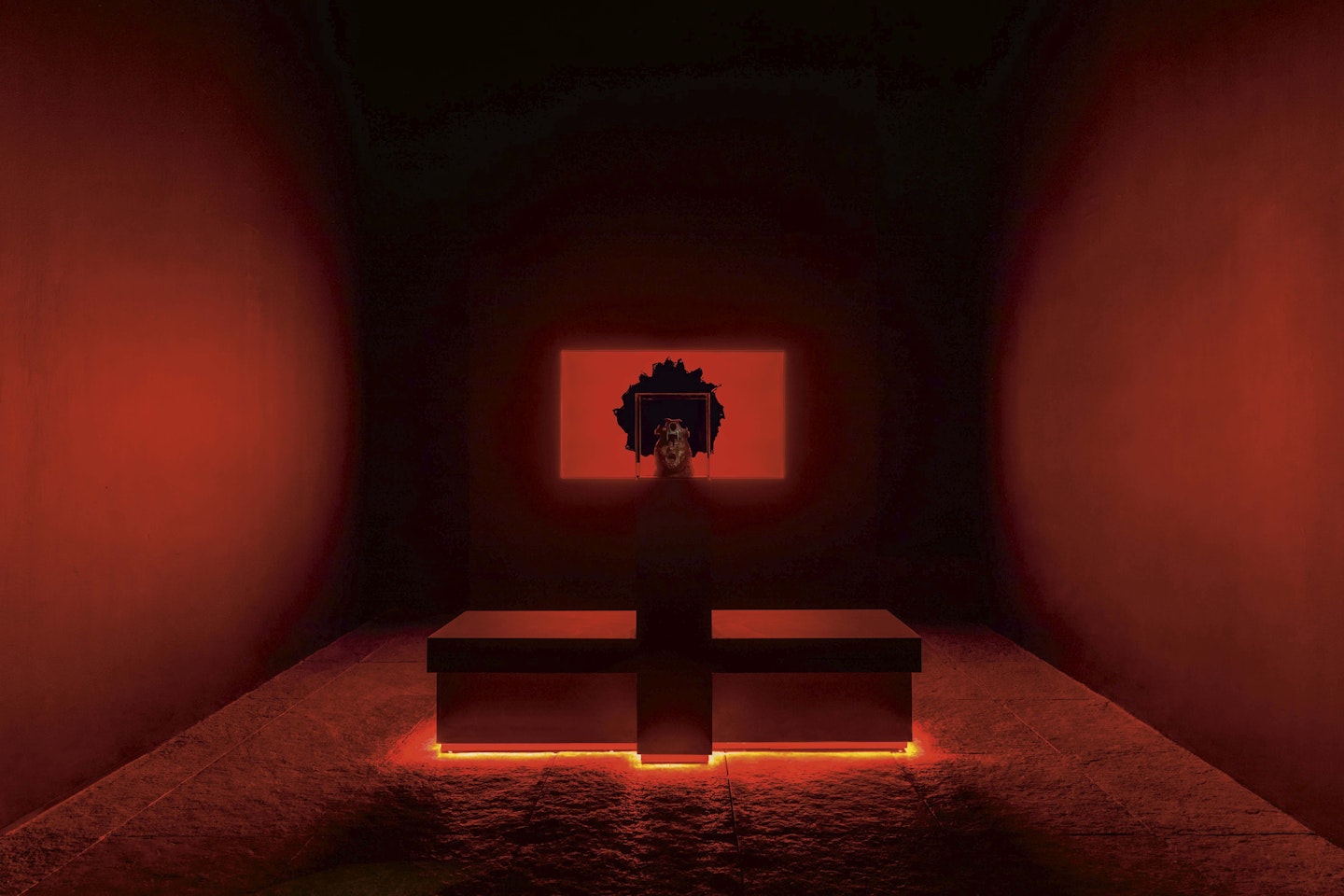
Entitled Cosmogonia Colérica, this exhibition points to an explosive genesis, a poetics of worlds born amid ethereal fervors and social convulsions. Assembling 21 works produced between 2013 and 2025, the show presents the wide range of media and scales with which the artist works, as well as the different phases of his trajectory. The curatorship, however, does not seek to be exhaustive or anthological, but rather to activate a system of relations among the energies of each work. In this sense, curatorial thought has been guided in greater part by impulses than by chronological, thematic, or formal proximity, proposing dialogues that emerge in space and in the forces the works themselves radiate.
Each work gathered here is a portal. In the large images as in the smallest details, in the explicit and in the hidden mysteries, there is an immensity of symbols to be experienced. Like a multidimensional vortex, urgencies of the present arise alongside millennial echoes, scenes of daily life intertwine with oneiric visions, esoteric symbols with revolutionary trances, dense matter with interworldly paths. Hovering above all, unmistakably, is the continuous cycle of life, summoning us to a scorching journey under the flame that ceaselessly transforms all things.