Ultratremor
2026
Germano Dushá is a curator, writer, and cultural agent with a law degree (FGV Direito SP) and a postgraduate degree in Art: Criticism and Curatorship (PUC-SP). At the intersection of aesthetics, critical thinking, and esoteric traditions, his practice assumes multiple forms—as curatorial, literary, and hypermedia experiments—to investigate social imaginaries, and to dwell on the energy fluxes connected to radical subjective experiences and transmutation processes.
Contact germano@ofora.org
1. Embracing the Unknown
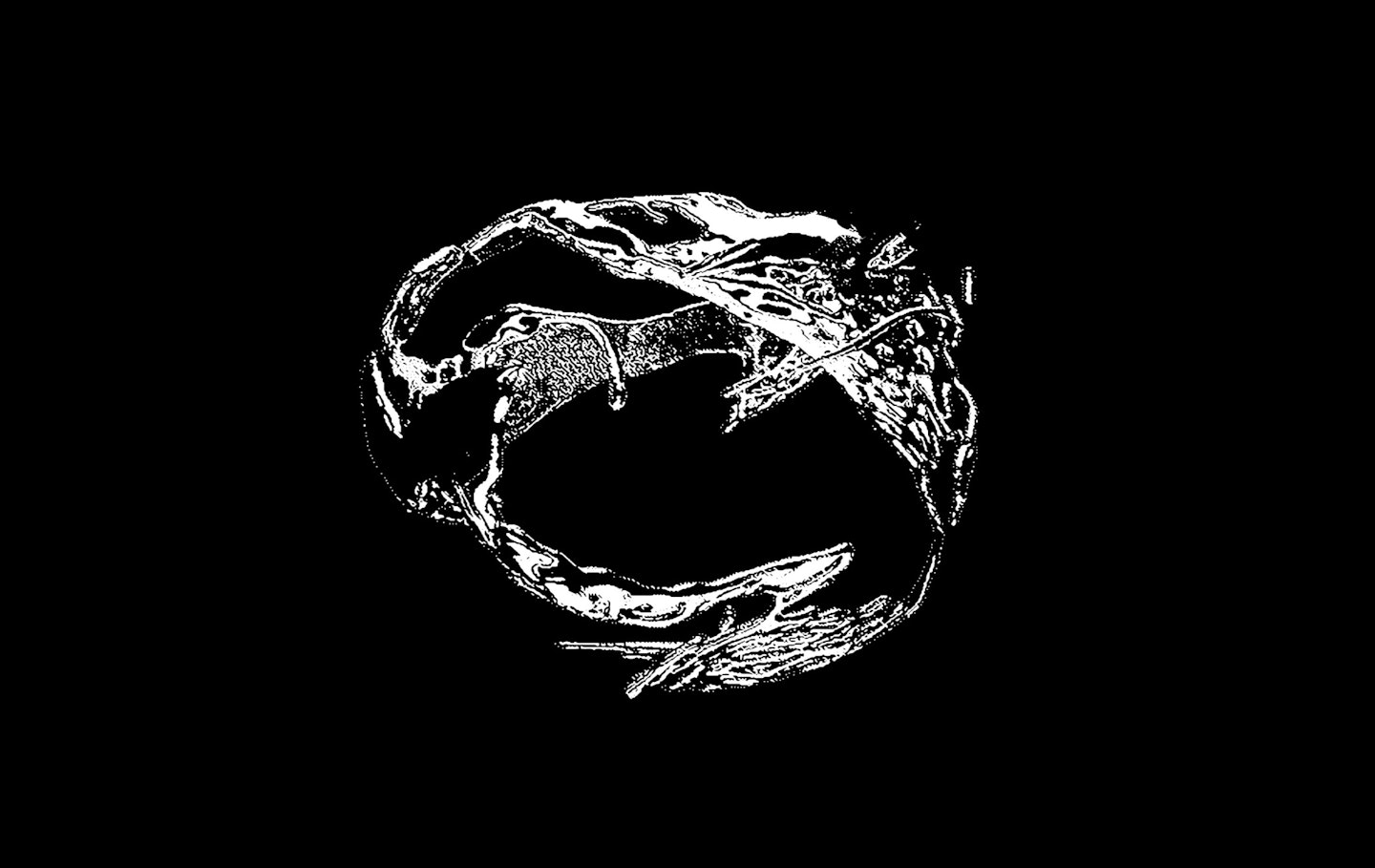
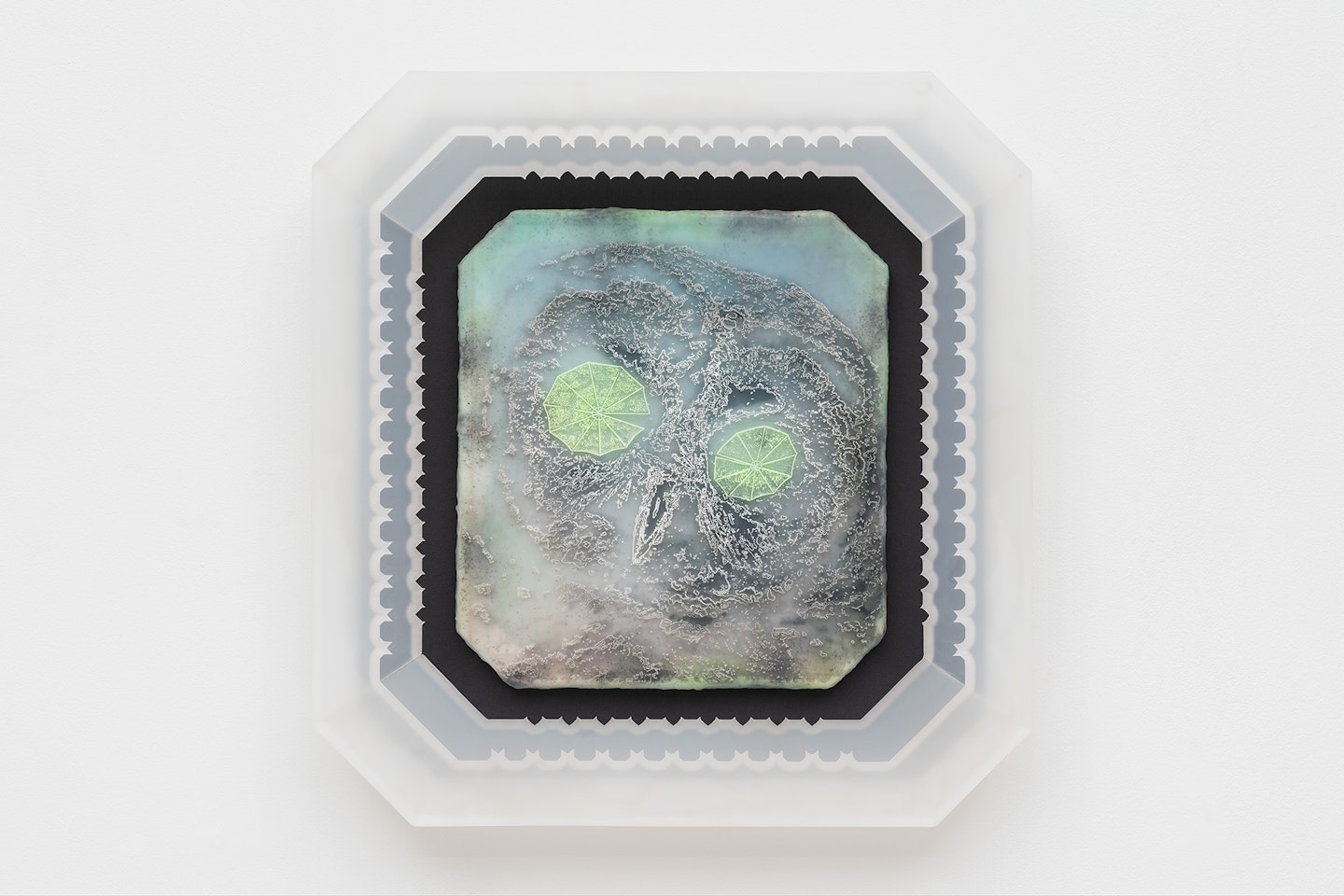
A crucifix, a mask, an organ. The hybrid body of animal feet fused with football boots, sheathed in a skin of inconceivable, hallucinatory colors and textures. Chromed tree branches expand into the room like eerie, rhizomatic creatures. A sheet of metal, seemingly opaque, suddenly reveals its liquid constitution. Burnt acrylic plates rise as mute mirrors from a forgotten future. Coffins and crosses of compacted turf form dense grids. A constellation of star-shaped grasshoppers glued together takes over a wall, as if part of a stellar ritual. Empty beehives emit an artificial but strangely comforting hum. Springy, translucent tubes crammed with electronic cables and organic residue stretch through the space like exposed nerves. All part of a myriad of critters from an unnamed nature.
To make contact with the work of Adriano Amaral is to step into a liminal zone where echoes of the familiar are subverted by cryptic codes. Here, in the intricate play between the discernible and the utter dissolution of reference, our cognitive apparatus is destabilized, overwhelmed. His weird—and at times eldritch—objects and arrangements take us into uncharted territory; they disrupt our ordinary relation with the world, and show us how unstable our systems of meaning really are. As perception is recalibrated and one tries to bridge the seen and the intelligible, signifier and signified, the mind becomes porous and imagination runs wild. Such an ontological fracture pulls the viewer to the very boundaries of language.
The artist stages an intense exercise, inviting us to access the unknown head-on, to become intimate with that which resists deciphering. Every outlandish, abnormal, and ghostly apparition provokes us to examine and experience its presence without quite making sense of what is in front of us. The paradox of this encounter lies at the root of a fundamental human drama, torn between self-preservation and the aspiration to cross thresholds. This also defies the modern compulsion to control, identify, and classify, propelling us to relate to what cannot be defined. Amaral’s hypnotic work triggers the ethereal thrill, that trembling moment when dread meets fascination. It takes us into a field beyond description, where knowledge is felt before it can be thought.
2. Channeling as Praxis
Adriano Amaral’s practice draws from a vast array of materials. From natural residues to industrial products, from personal belongings to technological fragments, his choices are guided by attraction. Anything that exerts a pull is incorporated and reconfigured until it resonates. What is important to him is not the origin, function, or status of a material, nor its conventional place in culture, but its capacity to contribute to his investigations into matter, meaning, and energy.
This is why his works seem coded from an ever-expanding genetic inventory: silicone, acrylic, aluminum, steel, plaster, rubber; LCD screens and solar panels; worn garments, computer debris, fragments of furniture; bones, feathers, skins, nests, and exoskeletons; twigs, stones, and soil. Each element bears equal importance, bringing specific information capable of altering the alchemy of the whole. The inventory is cumulative, layered, and never closed. Each new addition reshuffles the archive, creating circumstances for new assemblages.
His approach to physicality is hardcore. It is based not only on recognizing the inherent instability of matter—the fact that everything is in continuous transmutation—but on pushing that condition to its limit. Amaral seems compelled to transform whatever he can put his hands on, as if to test how far its substance can stretch, what new forms it might adopt. His studio resembles a laboratory, filled with countless procedures: burning, melting, vaporizing; cutting, combining, and reforming; molding and casting; slicing and smashing, in a choreography of trials.
This meticulous experimentation is always infused with a feral intuition. The result is not the plain product of technique but something born of both method and insight, exceeding the full control of the artist and carrying unpredictability at its genesis. Accordingly, the more deeply Amaral delves into the material realm, the closer he gets to the immaterial qualities of things and their spiritual dimension. At times his work recalls that of an ancient maker of the forest, gathering rocks, branches, leaves, and animal remains to fashion talismans and apotropaic amulets—objects invested with transcendental faculties, used for invocation and protective powers. These artifacts were never made for mere aesthetic appreciation; they were portals, tools for connecting different dimensions. Amaral metabolizes this archaic energy without imitation or pretension. His works do not belong to any folk tradition or religious deeds, but they carry their fundamental élan: organisms assembled to emanate. Instead of being representations, they radiate forces, standing less as icons and symbols than as entities vibrating in themselves, alive with their own peculiar agency.
Although Amaral’s practice encompasses several media and extends well beyond the confines of the object, the sculptural remains his fundamental mode of thinking. His visions rarely hover as mental concepts; they manifest through gestures that grant them material contour. He thinks through matter, allowing it to reveal possibilities. This is sculpture as an embodied form of inquiry: a way of asking questions through letting things mutate until they reach a certain frequency.
In this sense, his practice can be described as “channeling.” His objects, paintings, and environments do not come out of linear, rational plans. Instead, they materialize by yielding to instinct, to serendipity, to the innate appeal of things, to the impulsivity of gesture, and to the amalgam of disparate essences. To grasp the uncanny is Amaral’s methodological pathway. By allowing himself to be guided by what is beyond comprehension, he makes space for the invisible to speak through him, allowing singular ideas to coalesce into enigmatic presences within the physical world.
3. Unfathomable Ambients
To enter one of Adriano Amaral’s environments is to abandon the mundane coordinates and surrender to the vertigo of a strange fantasy. Mist and mystery. Charged atmospheres. Anomalous phenomena. Bright lights and crepuscular shades sliding over metal surfaces, gleaming like omens. Landscapes that feel otherworldly, populated by alien-like beasts. Interiors that oscillate between spaceships, research labs, and ceremonial chambers from a lost—or not-yet-arrived—age.
What follows is less an act of contemplating than that of inhabiting. Each glance challenges the mind’s attempt to process information. Temporalities overlap: one might feel suspended between an alternative medieval past and the speculative outlines of a distant future. Boundaries dissolve: the organic merges with the synthetic, and matter flows in between states, blurring distinctions between solid, liquid, and gas. It’s impossible to tell growth from decay. Words hesitate and stumble, while the effects of impressions migrate from the mind to the nerves, leaving a chill in the bones, a tightening in the chest, a pressure inside the throat. When categories fall apart, consciousness dissolves into deeper corporeal registers.
In his environmental practice, Amaral’s artistic vision reaches its peak, as he deploys his infinite material and procedural vocabulary. His installations surround and engulf the viewer, operating as expanded sculptures that demand the full engagement of the body. They are intricate and hyper-detailed, full of images that strike instantly alongside elements so subtle they are almost imperceptible. The impact is visceral, more akin to the excitement of a haunted attraction, a freak show, or a strong scene from a horror film, where aesthetic experience reaches a physiological level.
As a builder, Amaral responds with acute sensitivity to the contexts he occupies. His installations do not dominate architecture but inflect it, amplifying certain aspects. With his techno-druidic poetics, the artist intervenes to enchant the site. He creates rhythm with textures, colors, and shapes, and oxymorons with components of disparate origins, staging puzzling metaphors in matter. Each element functions like a line in a broader composition, so that the installation as a whole reads as a poem written across space. Multiple fragments of an abstract narrative carved in all kinds of material.
These auratic spaces, with their psychological and dramatic qualities, reveal a fundamental truth: matter is never passive, and objects cannot be reduced to function or symbolism. They act and react, withdraw and reveal, exerting a presence that outruns interpretation. What grips the viewer is the recognition that the material world holds an autonomy that resists human jurisdiction. To be inside one of his works is to be reminded that our existential role is not to understand and control things fully but to live in confluence with them.
In the same way, Amaral’s installations state an inescapable ecological axiom: the fact that life is a total mixture. They highlight the circulation of a pulse binding all pieces into a continuous, common field. They embody the recognition that existence itself is movement and interdependence, so that nothing exists in isolation, nothing remains sealed; everything is entangled in a dynamic web of exchange, affecting and being affected. Hence, there is no separate, exterior world, only the same energy flux that is within us and everywhere else.
His bionomic environments emphasize the fact that we are always already inside this mesh, implicated in a vital pact between all forms of life. Likewise, there is no pure, grand nature to be discovered, to be managed or to be saved. What they do is confront us with a monstrous ecology that is inapprehensible and unfathomable, and which, nonetheless, is precisely what we are made of.
4. The Dawn of a New Century
From the crucible of Adriano Amaral’s experiments emerges a refulgent, baroque futurism, a sculptural language forged from the contradictions of our contemporary juncture. His work conjures extreme morphologies: humanoid and bestial figures, universal symbols bent into grotesque mutations, residues crystallized into improbable configurations. Between the ferocity of the world and the magic of life forms, he stages a tale of the wonders and the wreckage of this age.
The spell of his conceptions lies in a double pull. On the one hand, a gloomy yearning for an origin we cannot simply restore. On the other, the vibrant desire for what lies ahead. Drawn by this tension, we approach them in awe, only to find ourselves reflected back. However bizarre, however unrecognizable, his creations return to us an image of what we are, what we have been, and what we might become. They operate as portraits of the human journey, refracted through nameless renders, reminding us that we, too, are composite beings caught in perpetual transfiguration.
Amaral’s practice, thus, is not merely reflective but annunciatory. His chambers function as speculative stations that encapsulate the sensation of living under the dusk of this century. They expose what we already feel in our spines yet struggle to articulate: that the most decisive interrogations of our time are no longer abstract formulations, but are actualized in material reality. What does it mean to be human at this threshold? What forms of existence are being born and undone by the work of our hands?
The backdrop is one of radical instability. Ecological hecatombs, political turmoil, social inequity, and technological acceleration converge into an unprecedented horizon. The current phase of late, cybernetic capitalism is inseparable from human activity, yet surpasses its agency, subjectivity, and frameworks. A voracious intelligence that accelerates its own metabolism, in the manner of a cancer cell. At once a product and a parasite of humankind, it expands at any cost, indifferent to whether its host survives. Its development is bound to our exhaustion. Amaral’s works resonate within this dystopian scenario, staging forms that appear at once vivacious and terminal, incandescent and disintegrating.
It is here that the figure of Prometheus acquires renewed urgency. In the narrative of Greek mythology, the Titan of foresight stole fire from the Olympian gods to grant it to humanity as a tool for survival and an instrument of evolution. This gift made possible the emergence of civilization and culture, yet it carried a catastrophe within. The myth reveals the Promethean nature of the human condition: to thrive through invention while living under the menace of what it unleashes. The device that once secured life now threatens to consume it. The same hand that forges the world sets it ablaze.
Written amid the upheavals of the Industrial Revolution, Mary Shelley’s Gothic novel Frankenstein; or, The Modern Prometheus sharpened this notion. It is not simply a warning against god-like science and its dreadful consequences going unchecked, but an allegory of creation’s dilemma: when what we conceive escapes our intentions. At the core of this tragedy is the drive of human ambition—burning forward into unforeseeable frontiers. Its most prophetic element, however, lies not in the plot but in its reception. Popular imagination mistook the creator for the creation, giving the creature the name of its maker. “Frankenstein” is what the monster would come to be called. This confusion is telling. It reveals that there is no clean separation between inventor and invention. Whatever we produce rebounds into us; whatever we fashion, we inevitably become.
In this sense, this misnaming foreshadows the collapses of our epoch. The boundary between human and machine is no longer stable. We are already cyborgs, already enmeshed with gadgets, prosthetics, and networks that transcend our understanding and management. Artificial intelligence only makes explicit what was long underway: our tools are not external equipment but autonomous extensions of ourselves, animated by our programming, our archives, our visions. And soon, they could completely replace humanity as we know it.
Ultimately, what seems inexplicable and cannot be named in Amaral’s pieces does not estrange but rather beckons, drawing us towards a new economy of attention, new perspectives, and possible affections. At the edge of the occult, being attentive to matter’s tremors can become a passage into transcendence, revealing metamorphosis as our inescapable destiny. His work sheds light on the most vital issues. It confronts us with our existential role in the face of the enigma of transformation that runs through all that exists.