Ultratremor
2026
Germano Dushá is a curator, writer, and cultural agent with a law degree (FGV Direito SP) and a postgraduate degree in Art: Criticism and Curatorship (PUC-SP). At the intersection of aesthetics, critical thinking, and esoteric traditions, his practice assumes multiple forms—as curatorial, literary, and hypermedia experiments—to investigate social imaginaries, and to dwell on the energy fluxes connected to radical subjective experiences and transmutation processes.
Contact germano@ofora.org
A beam of light trembles:
a stroke that opens a new reality.
It shows the organic geometry of the hills
fitting into improbable arrangements,
the eye of the earth filled with water
until it becomes a river
and, in the falls,
descending swiftly, once and for all,
the wet green of the forest
and the arrival of the grass ignited by the solar ray,
the changing blue of the first sky,
and from the peak of noon on the beach
to the intense darkness of the dense night
in which the stars appear
in a silvery spectacle,
comforting us after the death of the day,
when the clarity, once total, fades away
reducing the colors,
on the thread of nostalgia,
leaving us at the mercy of the immensity,
the vast expanse,
from where we came and to whose arms we will surely return, only to begin everything again.
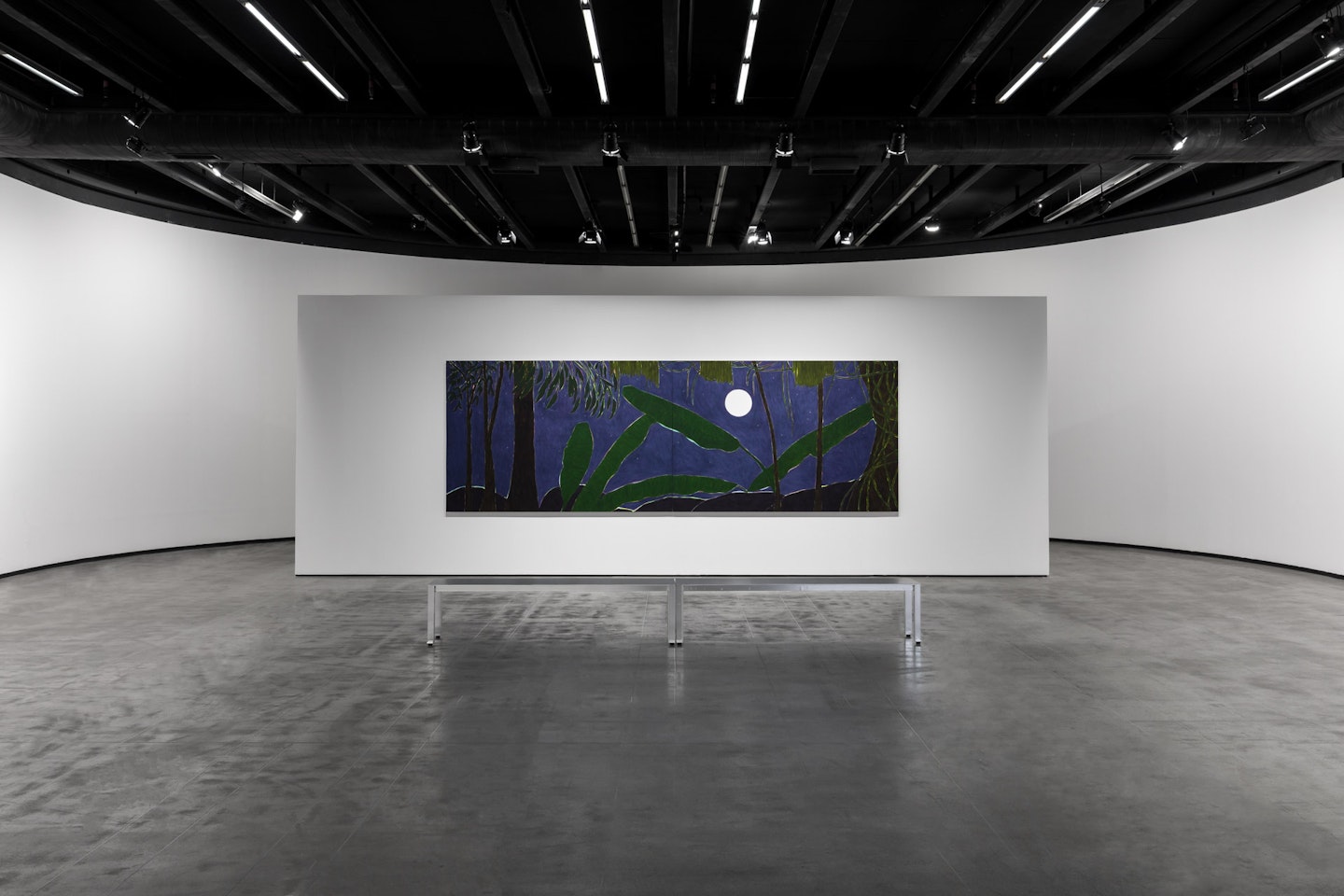
The exercise about the energy and dynamics that shape nature, in a free play with its lines of force, is at the heart of Patricia Leite's work. Over 40 years of her career, the artist has followed a path that brought together various interests and mediums, yet preserved the same pictorial desire, characterized by synthetic solutions, large blocks of color, and intentionally open and fluctuating strokes. In her works, a sensitive tear in the void pulses until it splits into a chromatic quiver – like a small horizontal portal that radiates a range of lights, aspiring to new possibilities. From this movement of opening, things emerge in their essential manifestations, from the most elemental, such as the firmament, the Sun, the Moon, the stars, plains, seas, and mountains, to the ornamental ones, which provide the finishing touches to reality as we know it.
Her areas of interest are diverse, encompassing art history, Brazilian music, cinema, and literature. Similarly, her sources of inspiration are many: experiences etched in memory, photographs she has taken or found in the world, verses from poems, song lyrics, great artistic achievements, scenes from films, and anecdotes collected from mythologies, novels, or conversations with friends. In a balance between the magnetism of Brazilian identity and a universal calling, her work celebrates what is unique in Brazilian culture without, however, limiting itself. Although scenes of Brazilian forests and coasts are recurrent in her paintings, there is always a desire that points to the core of human experience. From the regional to the global, and from the grand narratives to the most mundane aspects of everyday life, whatever concerns her and captures her attention is absorbed and metabolized with due calm. First, these fragments settle into a mental field to then be studied for their emotional and material qualities, until they take form in compositions that synthesize nature in an intertwining of feelings and meanings.
Her works propose a vibrant reorganization of natural phenomena, emphasizing the result of encounters between different elements in the world. The chromatic fields juxtapose organically, creating contrasts in a free geometry and forming landscapes that are more or less discernible, sometimes more solid and calm, at other times fleeting, as if flowing quickly. However, the vibration of the stroke always stands out: varying lines that bubble, outlining things without closing them, in order to highlight the elastic movement of life. The loose and vigorous step, marked by fluid gestures and dynamic rhythm, denotes the bodies’ ability to transmute, whether in relation to the larger world or to their own constitution, as if the substance that composes them were in continuous action. With an intensely graphic style, the artist works in the elegant weaving between simplification of form and emotional depth. Instead of documenting these fragments of the world that crossed her, Patricia Leite creates what she calls “sensations of landscapes” , schemes that reconstruct places from their evocations. Although economical in their fundamentals, her paintings transliterate the deepest aspects that landscapes inspire, summoning a myriad of emotions.
If, on the one hand, the simplicity of these representations conveys a certain lightness, on the other, underlying tensions are evident. The artist’s work balances a sense of wonder before the grandeur of nature— capable of transcending the limits of matter and reminding us of our immaterial essence—and a certain melancholic nostalgia, born from our smallness in the face of such vastness, which inevitably eludes us. In this way, it not only challenges the notions surrounding our perception of natural phenomena but also the limits of producing landscapes through language – that is, the cultural framework we create to make sense of our environment. Ultimately, it is a celebration of life, highlighting the flows of energy that unfold with each new discovery, each new day.
Titled Olho d’água, this exhibition brings together around 30 works, tracing a conceptual, formal, and temporal arc in Patricia Leite’s trajectory. Featuring pieces from the 1980s alongside new works created in 2025, the show presents drawings, paintings, and objects, offering the public a specific selection that testifies equally to the flexibility and stylistic coherence of an artist as inventive as she is true to her craft. Some of her most emblematic paintings are included – works for which she has become widely known in recent years – which interpret coastal landscapes, fragments of the forest, and starry skies through minimalist means. Also on view are some of her earliest works: a set of pastels on paper from 1986 and her first painting, an experimental act from 1988. These pieces reflect the qualities of her initial artistic explorations, in which total abstraction merely hints at what would later take on density in her figuration. For an uninhibited imagination, it will certainly be possible to glimpse the principles of a garden, a park, or a mountain range.
Like a loop, the newly created objects – made between 2020 and 2025 – shed light on the fundamental choices in her work. These small pieces, assembled from found materials such as wood fragments, glass remnants, decorative trinkets, and polished stones, embody a contrast between delicacy and the rudimentary, deliberately affirming their incompleteness. Placed alongside her earliest abstract drawings, they seem to give form to diagrams of colors and textures. At the same time, they form small landscapes, recalling the beaches and hills seen in her more recent paintings.
The exhibition’s organization takes as its starting point the beam of light and its role as a mediator of optical perception, transforming our understanding of the world and revealing both its material nuances and its atmospheres and auras. Through delicate luminous traces emerging within fields of color, landscapes take shape, shifting between the experienced, the imagined, and the dreamed. At its core, the journey moves through different moments – from the zenith of sunlight to the passage of twilight and the deep darkness of night. In one corner of the exhibition space, the show offers a secluded place, immersed in the dense, mysterious humidity of the forest and the waterfall mist. Within these shifting scenes, small visual epiphanies emerge – enigmas that reveal and conceal themselves in the intimacy of the gaze, as if releasing continuous streams from the eyes, flowing like springs breaking through the earth to give life to rivers.