Ultratremor
2026
Germano Dushá is a curator, writer, and cultural agent with a law degree (FGV Direito SP) and a postgraduate degree in Art: Criticism and Curatorship (PUC-SP). At the intersection of aesthetics, critical thinking, and esoteric traditions, his practice assumes multiple forms—as curatorial, literary, and hypermedia experiments—to investigate social imaginaries, and to dwell on the energy fluxes connected to radical subjective experiences and transmutation processes.
Contact germano@ofora.org
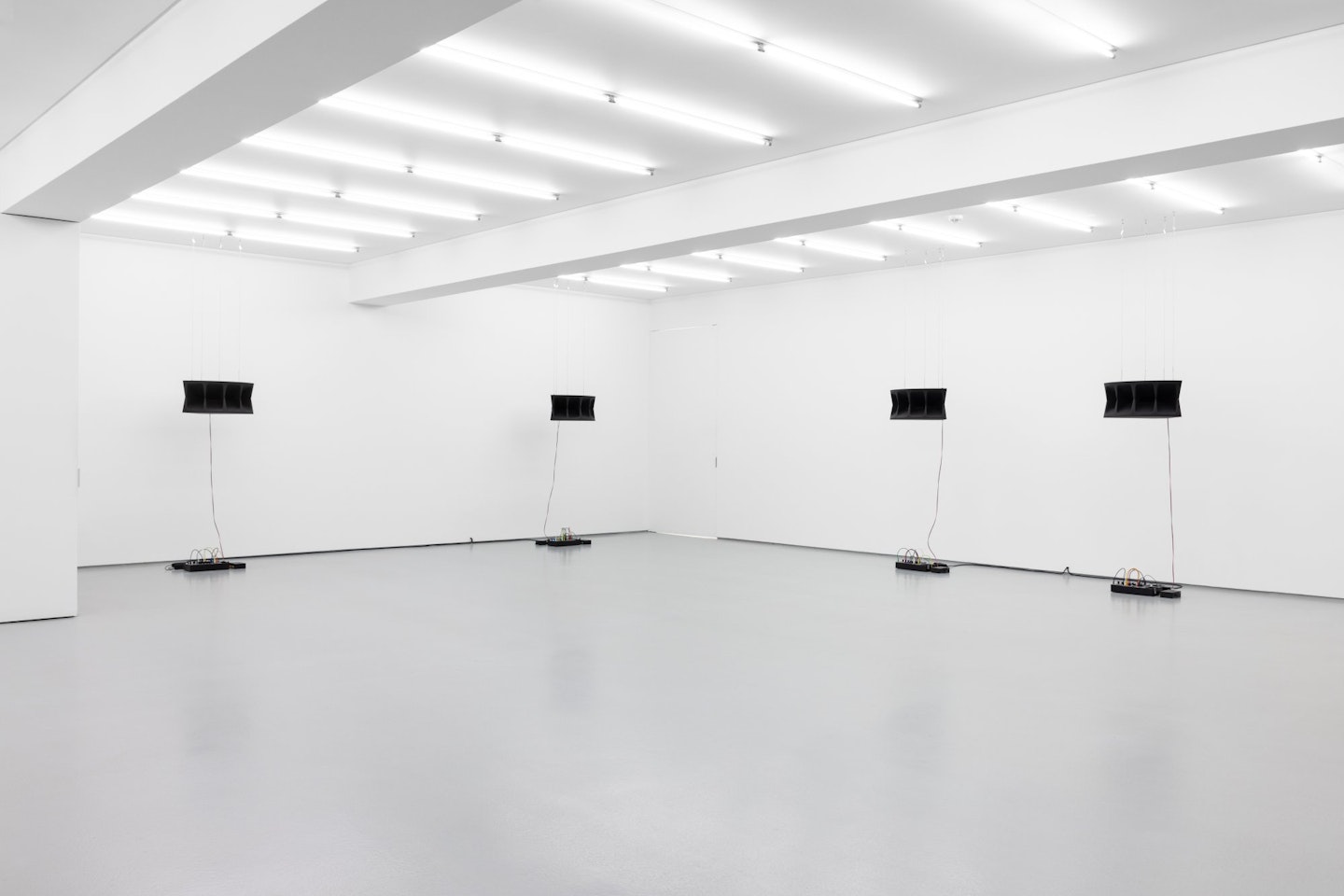
A black wall at the center of the gallery, as if covered by a dark veil, welcomes the audience into a magnetic void. It is a ground zero, a space to be filled by the perceptions of each individual. In this environment, the few objects on display offer different sensory experiences. There are four modular synthesizers arranged on the floor, each connected to a speaker raised high above: symbiotic bodies that, respectively, produce and emit a continuous sound. However, they will only allow these audios to surface if a body comes near. In dialogue with these pieces, there is a 35mm photograph that bears the only visible image in this exhibition. Although the photographed scene is apparently banal, there is an enigma within it that preserves the emotional gravity of the moment portrayed. Thus, the photo performs the same gesture of the sound installations: it reveals its inner frequencies only to those willing to approach its mystery.
Titled “Last Sounds”, this first solo exhibition of João Pimenta Gomes at Galeria Vera Cortês brings, through these specific incisions, the core of his research about the possible interactions—both physical and subjective—between body, sound, and space. In this sense, the artist combines concepts and sensory exercises, orchestrating analog and digital instruments to create environmental experiences and generate undefined, abstract, non-linear narratives. His works test our sensorial faculties, but above all our ability to process the world around us.
The four sources of sound located in the space embody a duality that contrasts the technological apparatus of their productive bases and the synthetic and economic forms of their communicative top. Whereas the synths make their internal mechanisms visible, with the chaotic aesthetic of cables and apparent connections, the customized speakers resemble mouth cavities singing through sharp teeth, in a manifestation resembling magic or an unknown technology. Their peculiar anatomy gives them the appearance of entities from the realm of science fiction. These big mouths remain covered until a presence invokes their reaction. However, when we get close they do not devour us, but instead allow us to hear the sounds that they produce. They break their vow of silence and begin to whisper in our ears, emitting something between the guttural, the archaic, and the notes of advanced technology. Their sounds invite contemplative meditation, but also awaken nostalgia and melancholy. Like a new liturgy, these tunes are requiems mourning the loss of the seconds that pass while we listen to them. They are meta-music about our own perception of space-time.
This procedure brings to mind a famous quote—with versions attributed to both Mozart and Debussy—about the essence of music not being in the notes but in the silence between them. Later, this same idea was epitomized by Miles Davis as: “It's not the notes you play, it's the notes you don't play.” Therefore, there is a clear reference to investigations into negative space in music, especially the legacy of John Cage and his 4’33”, the theories and practices of deep listening, and the core of ambient music. The composition with eternal loops, for example, reminds William Basinski's emblematic pieces. Finally, there is the definitive influence of spiritual jazz, a genre covering a wide spectrum of productions that combine exploratory aspects of jazz with Eastern esoteric traditions and themes related to spiritual transcendence.
In its turn, the photograph shows a human figure, under white clothes and blankets, whose bare hands hold a plastic fork and a piece of red velvet cake in a disposable metal container. In its gaze, the photography rescues the imagery of classic cinema, a time that produced perennial and lasting images. In its temporal suspension, we witness the cake about to be slaughtered, and can sense the flow of desires in motion and the existential layer behind the puerile scene. In this moment of transition, held between one bite and another, the figure elaborates their questions, resting the traumas of everyday life in the comfort of a bed and their palate. Close up to the image, it seems possible to hear the thin aluminum packaging being crushed by the touch of the hands, the fork piercing the cake, the noises of the digestive system, and the metabolization of feelings.
The physical configuration of the sound works, the phantasmagoria of their tunes, and the density of the photography contribute to create a dense atmosphere, building on the psychological dimension of liminal spaces. These places of transition evoke in equal measure familiarity and estrangement, welcoming and rupture, and a certain sense of waiting and suspense. Adding to the spatial situation is the suggestive title of the exhibition, embedded in an ambiguity that shall not be resolved. “Last Sounds” refers to the most recent sound pieces produced by the artist, and which now the public can listen to, as well as to the idea of essential, ultimate sounds. Met by these particular sonorities, as they pervade the environment when activated by our presence, we may think of a kind of ritual, a moment of self-knowledge and auscultation.
Holding the tension between absence and presence, the artist studies the intrinsic relationship between silence and sound, examining the metaphysical and physiological condition in which we find ourselves before and after hearing a sound, immersed in the silent moment. And because silence and sound can only exist in opposition to each other, we are provoked to come close and uncover the mouths, so they can either eat a comforting delicacy, or manifest their most intimate and fundamental frequencies: the “last sounds”.