Ultratremor
2026
Germano Dushá is a curator, writer, and cultural agent with a law degree (FGV Direito SP) and a postgraduate degree in Art: Criticism and Curatorship (PUC-SP). At the intersection of aesthetics, critical thinking, and esoteric traditions, his practice assumes multiple forms—as curatorial, literary, and hypermedia experiments—to investigate social imaginaries, and to dwell on the energy fluxes connected to radical subjective experiences and transmutation processes.
Contact germano@ofora.org


1. Cosmic Collisions and Quantum Entanglement
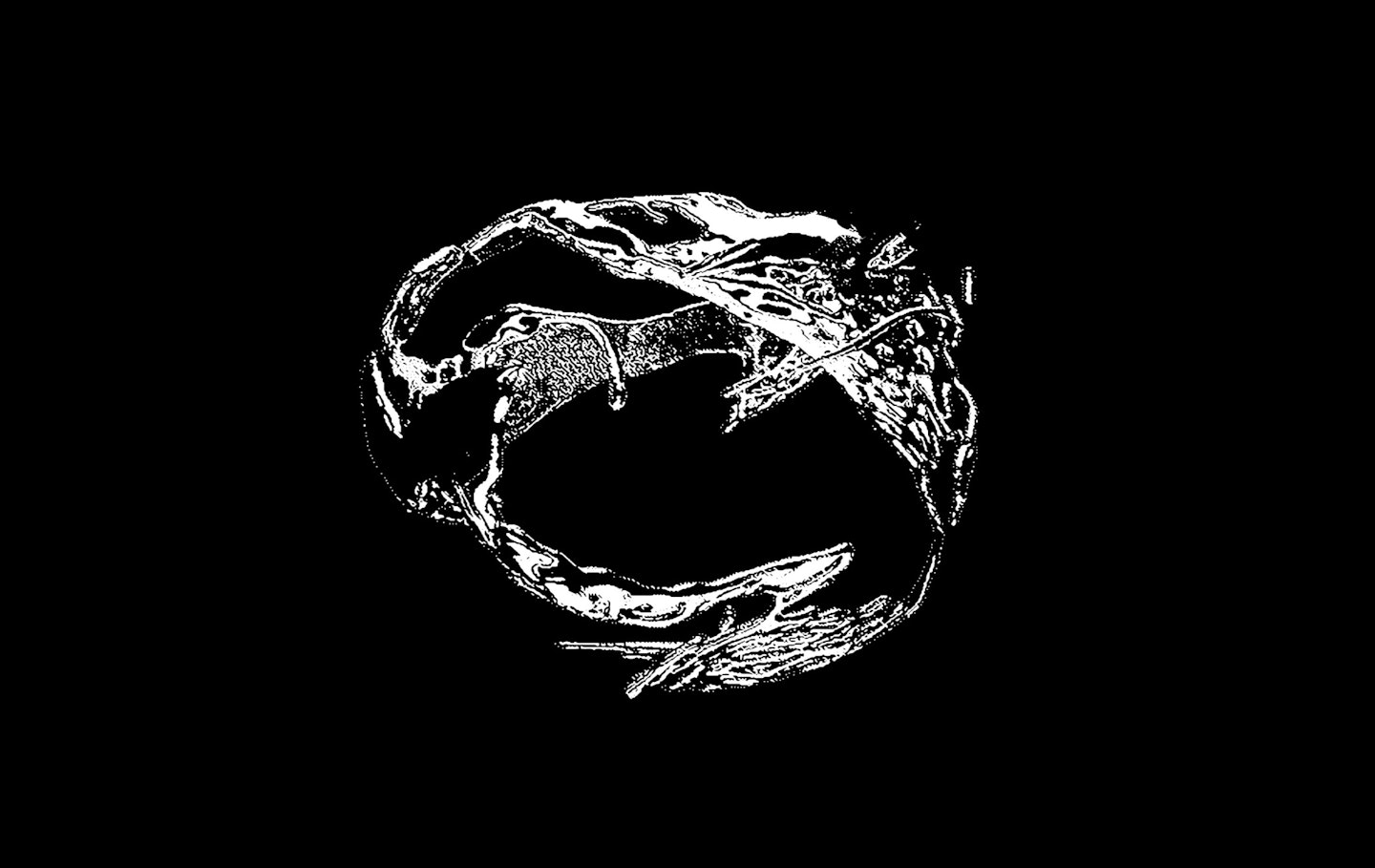
Let us imagine two or more energy systems of unfathomable complexity, with countless colors and textures, dancing in the immensity of the cosmos. They are clusters of stars and cosmic dust, gleaming like pearls in the vast darkness of the universe’s tapestry, performing choreographies in spirals and ellipses, in a gravitational ballet of profound beauty. Suddenly, these sidereal masses begin to interact at the limits of their capacities, deploying all their forces, until they devour one another in complete assimilation. These extraordinary events, called “cosmic collisions,” occur when two or more impassioned galaxies approach and intertwine, colliding significantly in a romance of fatal consequences and merging into one another. This process of entanglement can take millions upon millions of years and not infrequently culminates in intense stellar formation and the birth of new galaxies, unfolding into other forms of existence.
Moving from the very large to the very small, the mystery of life takes on special meaning in the subatomic realm, in a phenomenon known as “quantum entanglement.” Let us now imagine two existences connected in a transcendental way. Two objects with such a strong will to share in living that, even infinitely separated in space and time, they not only communicate telepathically but also exist in a continual teleportation, since any alteration in one is immediately reflected in the other. Considered one of the least intuitive and most fascinating fields of study in quantum mechanics, quantum entanglement refers to the event in which two particles are linked in such a way that the state of one cannot be described independently of the state of the other. It does not matter how far apart they are. Thus, even if countless light-years separate the particles, any change in the quantum state of one will directly and instantaneously affect the state of the other. The complexity of this intrinsic bond challenges the classical notion of locality, which postulates that separated objects cannot instantaneously influence one another. It is the ultimate manifestation of love and mutual existential commitment, resulting in a magic that goes far beyond our notions of time and space, of life and death.
2. Sensual Science and the Cannibal Sexuality of Spiders
As the vital enigma repeats itself in the universe at every scale, let us now study the fascinating amorous practices of spiders. Some species of this small eight-legged arthropod are supreme masters in the art of weaving, constructing webs through the production of silk threads that emerge from glands located at the rear of their abdomens. The spider, then, draws from within itself the raw material to build its own home, casting outward the substance that will form its shelter in the world, that will protect it, that will provide its food, and, when the time comes, will make it possible to find a mate and serve as a site for copulation. By spinning its webs with pheromones, the spider creates a natural chemical antenna. Once the signal is received, a potential mate will use the web’s vibration to signal its intentions, indicating openness to the encounter. Other communication techniques involve percussion—striking the web or their own bodies—and stridulation, rubbing certain limbs together. In this way, they create vibrations and sounds transmitted through the silk threads or the air, thereby making explicit their interest in sensual music. There are also arachnids that dance, performing dazzling visual displays to attract a mate. Through elaborate movements that reconfigure their physical constitution, these creatures translate their feelings, rendering visible what is happening within.
There are also species in which the female, being much larger or dominant, exhibits cannibalistic behavior, potentially devouring the male during or after the sexual act. This may occur especially in environments where food is scarce or when the female is unreceptive and reacts fatally upon disturbance. To avoid being reaped by a partner, males may employ various strategies, such as performing prolonged courtship rituals—investing in visual and vibrational stimuli and subtle touches—or offering mating gifts, usually a wrapped prey item, delivered to distract or satisfy her nutritional needs. In some cases, males use their own silk to immobilize the female. This bondage binds her, limiting the partner’s movements and increasing the chances of surviving the sexual encounter. As a last resort, once mating has occurred or even during the seduction process—if they detect some warning in the female’s behavior—males will attempt to flee rapidly, escaping the death engendered by sexual cannibalism.
3. Radical Surrender, Metamorphosis, and Fantasy in the Work of Maria Martins
We arrive, at last, at our main subject: the nuclear aspects of Maria Martins’s sculpture (1894–1973). Her works bear witness to all of this: what moves through us and moves us, the dynamics of affections, the surges of desire, inexplicable connections, fatal encounters, and the transmutation of the body after life experiences. Governed by the grammar of a singular fantasy and articulated through an acute technical mastery, her work inaugurated a vocabulary linked in equal measure to spiritual, psychic, and biological dimensions. The artist appropriated classical mythology, the principles of modernism, and the program of surrealism, then submerged them in the murky waters of an Amazonian river before releasing them beneath the humid mysteries of the tropical forest.
Her anamorphic figures address bodily alteration influenced by psychological states and by profound entanglements. In this way, they speak to the subject’s capacity to bear their feelings, as well as the body’s ability to manifest its metabolic processes. Concerning romantic unions, they deal with what remains of us in the other, of the other in us, and of the two in the world, after arms and tongues have met, after two have become one. We could say that, through the symbolic and iconographic force of her sculptures, Maria Martins’s work deals with the representation of these notions. However, that would be insufficient. Her work is not concerned with portraying or symbolizing the processes of the world, but rather with incorporating the concepts that give rise to them. Through an embodiment that assimilates the voracity of life, they express the essential state from which they are born.
Maria Martins’s sculptures carry an overwhelming magnetism, the kind that drags toward itself everything it can. There is no record of a body of work that has known how to give contour to mystery and conjugate the metamorphoses of the flesh as hers has. To metaphysical aspirations and existential astonishment are added the most intense actions of the soul incarnated in matter. Amid trances and ecstasies, fluid organic forms emerge along with their dynamics of expansion, contraction, torsion, dissolution, elevation, and who knows what else. These shapeless masses reveal a radical openness before vital drives, such that they assimilate the spells of other worlds and adopt interspecies and syncretic hybridisms toward that which does not yet have a name. In some way, it is as if emotions came to life before our eyes, manifesting in their essence, shaping and being shaped by physical substance. Just as feelings, perceptions, and desires evolve continuously, so too must physical bodies be in a process of constant modification, as a way of embracing new forms of being and of occupying the world.
The effervescence of affections under the heat of the tropics, the fascination exerted by impossible relationships, mystical experiences, and extraterrestrial phenomena are some of the ingredients boiled in Maria Martins’s cauldron, from which emerge: a subject tormented by a passion who then turns into a bird so that they can be near a forbidden love; the birth of a winged being; two bodies fatally attracted to each other, living the cannibal embrace of a symbiotic passion that will consume them; a figure in vertiginous motion driven by an implacable impulse; and much more. Those who have felt their vertebrae tremble, their organs churn, and their skin aflame in the presence of the one they love will understand these works. Those who have surrendered to the flames of the most fulminant passions, as well as those who have spent an entire lifetime atop the burning coals of enduring love, will understand as well. Those who have awakened in the middle of the night, devoured by an immense libido, and those who have experienced each second as infinite time, suffering the icy blade of longing piercing centimeter by centimeter of the body. Those who have wanted to trade everything for a mere touch from an unreachable person will also be able to approach the meanings of her sculptures. And, especially, all who embrace the mystery that accompanies the advent of a new feeling, facing the complexity of metabolic processes, dissolving and remaking themselves with each new relationship.
Everything that is life is movement. In the moment we love, we have already become another. Total transformation is the inescapable destiny of those who love.