Affirmation Room
2026
Germano Dushá is a curator, writer, and cultural agent with a law degree (FGV Direito SP) and a postgraduate degree in Art: Criticism and Curatorship (PUC-SP). At the intersection of aesthetics, critical thinking, and esoteric traditions, his practice assumes multiple forms—as curatorial, literary, and hypermedia experiments—to investigate social imaginaries, and to dwell on the energy fluxes connected to radical subjective experiences and transmutation processes.
Contact germano@ofora.org
The flame of chaos licks every corner: it sends animals and people running, flares up the appetites of the flesh, stiffening the limbs, pricking up the ears with the sound of swirls and roars, of couplings and consummations. A rumble grows stronger, a heavy colossus, and soon arrows whistle, blades flash, wars break out, caravels appear in the bays and tractors in the jungles — monothematic annihilation. By convergence or distinction, by passion and procreation, or by sheer brutalizing destruction, compositions, and contrasts emerge, the fear of the abyss and the abundance of nature. The lights of the stars shine in the waters that bathe the soil that hides the fossils, once dental arches full of tongues. Encantados and chants, shots and drums, the monsters and tides of Maranhão. A thousand howls, groans, or outcries, shoot out facing the astonishment of existence itself. They pass through the rib cages, climb through the throats, gain momentum and, in a fatal impulse, make the bones in the mouths tremble, streaming into the world. The unveiled ascent fatally reaches the sky. Final act: the voices are transmuted from matter to cosmic dust, diluting in the creative energy that moves the gears of the whole, echoing in the immensity of infinity.
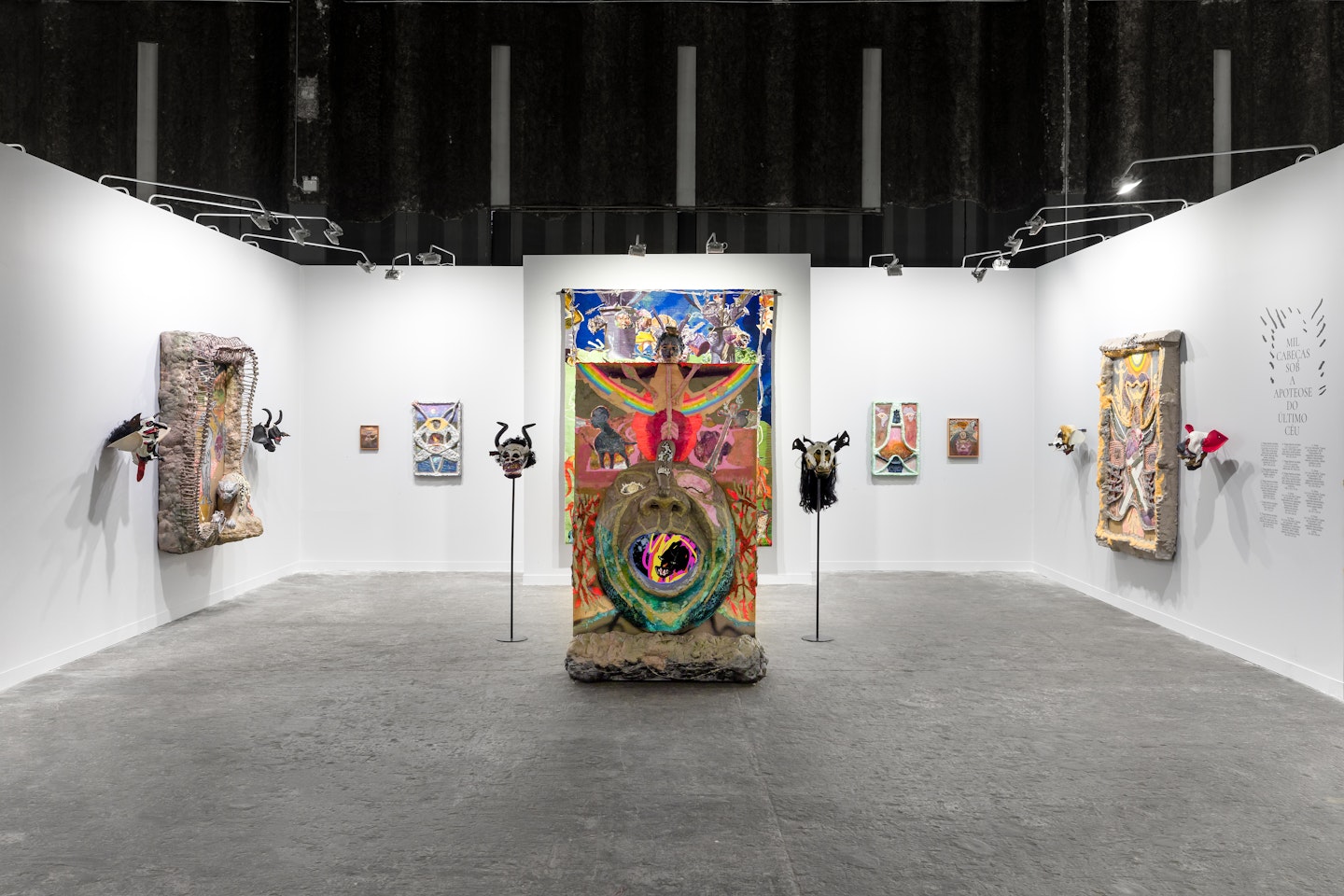
Lima Galeria’s project for SP-Arte Rotas Brasileiras 2023 interweaves the works of Zimar and Thiago Martins de Melo, two artists from the state of Maranhão with different backgrounds and practices, but a shared inventive vigor. Entitled A Thousand Heads Under the Apotheosis of the Last Sky, the project exhibits recent works by each artist in a harmonic composition that gives rise to an apotheotic situation.
The creations of Mestre Zimar, whose greatness is attested by his popular title, are based on his experience as a player of Cazumba in one of the strongest cultural manifestations in Maranhão — the “Bumba meu boi”. Cazumba plays an important role within this narrative structure. Their gender is undefined, they do not belong to a specific biological species, as a person or animal: they are magical beings. In folklore, their function is to open the circle and establish the play, interacting directly with the public and the other characters. Their figure — half man, half beast — always bears a striking feature, causing astonishment and delight, fright and amusement, all at the same time. The Cazumba are notorious for their "grimaces", which are complex and elaborate masks, and for their "garb", ornate robes that are always colorful and colorful. Frequently, they also carry a "badalo" in their hands, a small bell used for herding oxen, which they play rhythmically and incessantly.
Member of the "Bumba meu boi" groups in his city, mainly the Boi Flor de Matinha, Zimar makes the faces — or chins, as these masks are also called — as pieces capable of activating other possible existences. The vitality of his creative force gives rise to unseen hybridisms. He creates heads for those who embody their own transmutation, converting the participants into magical beings of an inexpressible nature. By handling different materials in a practice as virtuous as it is anti-disciplinary, the artist conceives a form for the images that appear in dreamlike visions or observations of the world, incarnating matter with his monstrous figures. Each grimace possesses very peculiar characteristics, affirming its own subjectivity. Together, they represent countless distinct personalities, autonomous parts of a larger familial existence, or unique beings under a common language — the stylistic result of a great artist.
The works created by Thiago Martins de Melo also have unmistakable traits. His freedom of imagination, narrative vividness, and visual explosion combine figuration with abstraction, political comments with free fantasy, historical readings with biographical confessions. Vertiginous speed, critical insight, mythological breadth, and epic verbiage melt into the dense materiality of his painting. His works are thick on the surface and radically deep in content, proposing chaotic, circular, and anachronistic storytelling. Melo's neo-baroque style reaffirms violence as an incision point to address human horrors and sociopolitical urgencies, as well as to illuminate spiritual experiences and life's continuous capacity for reinvention.
Both artists use universal objects and symbols of Brazilian culture as the basis for unique and highly expressive creations. At the sharp crossroads between terror and bliss, they manage the monstrosity of matter toward existential transcendence. In this unprecedented encounter of their productions, each artist’s high intensity adds uniquely to a dramatic arrangement, charging the atmosphere of their shared environment, as a ritualistic space or force field where multiple characters and narratives circulate. They work on the fine line between the mundane and the mystical, the gore and the gothic, battles and games, monsters from Maranhão and their marvelous mysteries. Despite the inescapable brutality of earthly existence they celebrate, above all, the plurality of forms, the indomitable revelry, and the joy of living.