Ultratremor
2026
Germano Dushá is a curator, writer, and cultural agent with a law degree (FGV Direito SP) and a postgraduate degree in Art: Criticism and Curatorship (PUC-SP). At the intersection of aesthetics, critical thinking, and esoteric traditions, his practice assumes multiple forms—as curatorial, literary, and hypermedia experiments—to investigate social imaginaries, and to dwell on the energy fluxes connected to radical subjective experiences and transmutation processes.
Contact germano@ofora.org
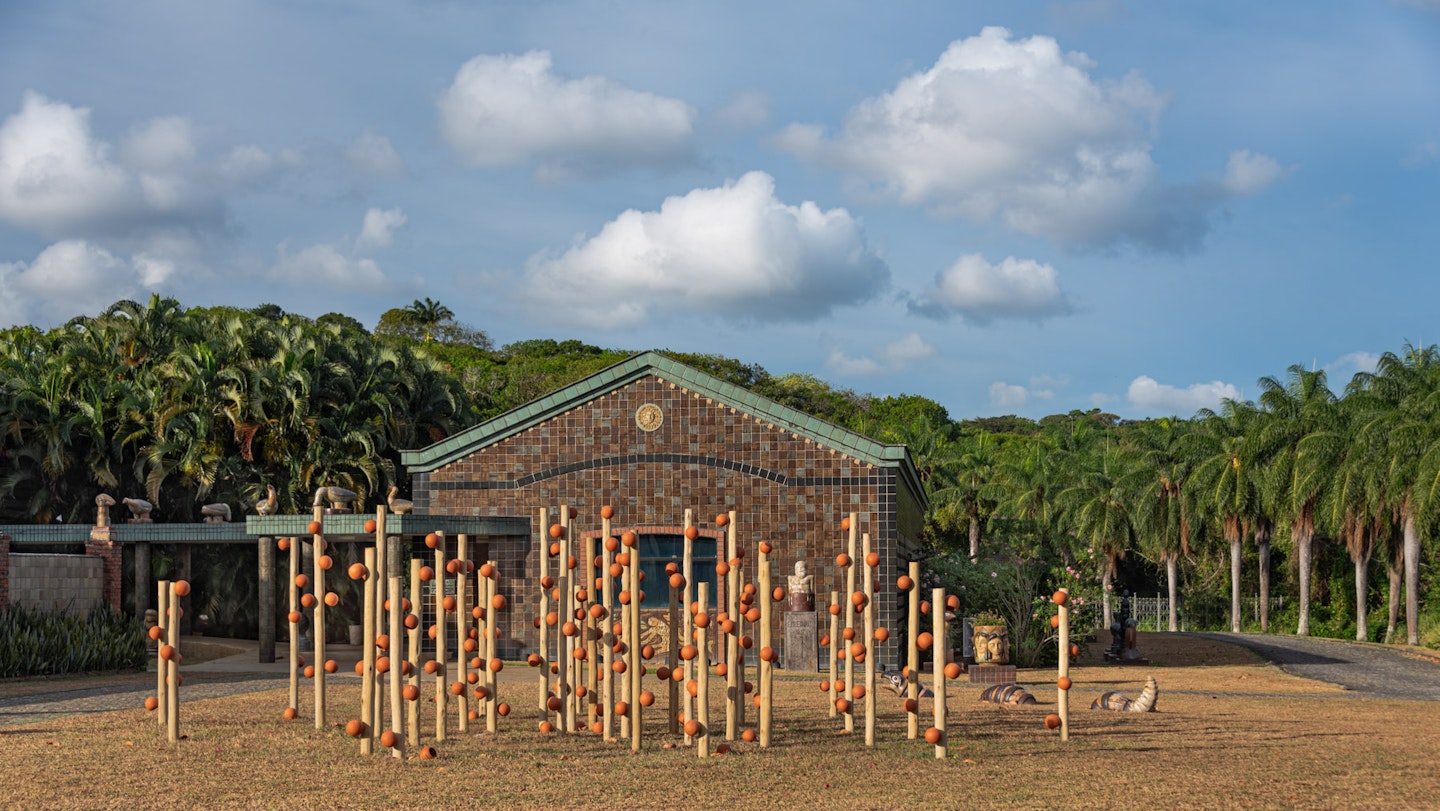
Cosmo/Chão is the sky striking the earth and the earth connecting us back to the sky.
It is the arc, the equivalence, and the reflection of one thing in another.
It is what lies below as much as what lies above.
It is the firmament, the soil, the circles, and the threads that bind them.
Conceived through dialogues between the work of Francisco Brennand and that of other artists, the exhibition stitches together two fundamental aspects of his practice. The first is sculpture in the expanded field—one that is not limited to figures placed on pedestals, nor even to objecthood itself. The second is the concept of territory, understood as the set of dynamics that shape and organize geographic experience, as well as the social and spiritual bonds that exceed the earthly realm and traverse different dimensions.
Sculptural practice—historically tied to classical traditions and their notions of form, space, and monumentality—has been rethought and expanded in both definition and scope, especially from the second half of the twentieth century onward. From the everyday figures and spiritual forms of countless ancient cultures to the marble and bronze statues of Greco-Roman antiquity, sculpture has long served as a device for mediating between the tangible and the imagined. But within the fissure opened by Modernity—and particularly in the critical and experimental revisions advanced by contemporary practices—its function and materiality have undergone profound ruptures. Artistic movements began questioning the limits of the object, transcending the physical body toward a field in which sculpture converses with time, environment, and the spectator’s body. This redefinition also engages new understandings of ancestral practices, in which sculptural making emerges as both symbolic and utilitarian, tied to daily life and to the invisible forces of the world. Today, sculpture can be understood as a mode of thought—a structure that incorporates concepts, narratives, rituals, and relations, challenging the traditional limits of art and proposing new ways of being in the world.
The idea of territory—often understood narrowly as a geopolitical boundary—is also a cultural construction. Territory is where modes of life unfold, where collective forms of organization take shape, and where bonds with nature and spirituality are forged. It is a circuit of forces that operates at the levels of the imaginary and the transcendental, constituted not only by physical occupation but also by ancestral energies and symbolic systems. It is a shared space in which different potentials and narrative disputes meet and reconfigure one another. Thus, territory must not be understood merely as the ground beneath our feet, but as the space that grounds identities, affections, dreams, and common projects. The communal choreographies that manifest within it are shaped by experiences of imagination, linking the tangible to the intangible, the present to the past and the future, and the earth to the cosmos.
Within this interplay, the project brings together artists from diverse contexts, techniques, and poetics to approach sculpture as an exercise in territorial connection. Sculptural practice thus appears not only to address the material, physical body, but also the body as a signifier of identity, in its spatial or ethereal dimensions. We may think, then, of at least three interpretive paths—often overlapping—to approach the works gathered here. There are collective practices, permeated by processes intrinsic to the communities and groups in which they are made. These works act as conduits of shared knowledge and tradition, especially when sculpture is understood as the agency of non-individual processes and authorships. Then there are contextual practices, implicated with places—their histories, cultures, and materialities—shaping reality by reflecting or acting directly upon the environments they inhabit. And finally, there are fabular practices, from which emerge works that incorporate or represent ideas, visions, and imaginations of worlds, where the narrative potential of sculpture is activated to fictionalize, give meaning to, and materialize other spaces and stories.
Cosmo/Chão proposes an idea—at once defined and open-ended—to evoke the mysteries of the soil that connects beings and grants them a sense of belonging; to speak of the entanglements of the relational arena; and to aspire to what transcends the physical plane, embracing the immaterial. Cosmo/Chão is the idea descending into earthly form, and it is the ground rising into a body. It is the infinite held in a handful of earth. It is the whole contour within a single shape.