Fotofantasma
2026
Germano Dushá is a curator, writer, and cultural agent with a law degree (FGV Direito SP) and a postgraduate degree in Art: Criticism and Curatorship (PUC-SP). At the intersection of aesthetics, critical thinking, and esoteric traditions, his practice assumes multiple forms—as curatorial, literary, and hypermedia experiments—to investigate social imaginaries, and to dwell on the energy fluxes connected to radical subjective experiences and transmutation processes.
Contact germano@ofora.org
1. The Light of Uncertainty
A thick mist spreads over the world, swallowing contours, blurring the horizon, suspending time itself. The sea lies still, silent, its fixed surface interrupted only by the intermittent whisper of waves. The land is uncertain, as if on the verge of forming itself. One is confronted by an imprecise light, a diffused clarity that erases distinctions rather than defining forms. It is the moment before perception stabilizes, before the eye can claim what it sees.
In one of the most celebrated Brazilian literary masterpieces, Triste Fim de Policarpo Quaresma (1), Lima Barreto (2) describes such a condition: “It is not night, it is not day; it is not dawn, it is not dusk; it is the hour of anguish, it is the light of uncertainty.” As “a floating white darkness” veils everything, reality turns into a frail game of apparition and mirage. Under this unstable hour, the familiar turns into the unknowable, and the vastness of nature imposes itself on human fragility. “To the left and to the right, it is the unknown, the Mystery”.
To experience the work of Lucas Arruda is to be absorbed in this very threshold. A suspended state in which the vision teeters between presence and absence. His pieces do not depict geographical locations, nor solid grounds. Instead, they stage the substances of the landscape, presenting atmospheres fueled with the anticipation of form—when light and color operate as forces of emergence and retreat. The horizon is always there, yet never entirely graspable. A rainforest, a desert, a sea, a sky—none of these are fully given, but rather sensed through countless layers of paint. Arruda’s practice is less about representing nature and more about suggesting its essence—summoning the sensation of a place rather than its image. His landscapes thus become instruments for conjuring memories and feelings.
2. The Desert as a Model
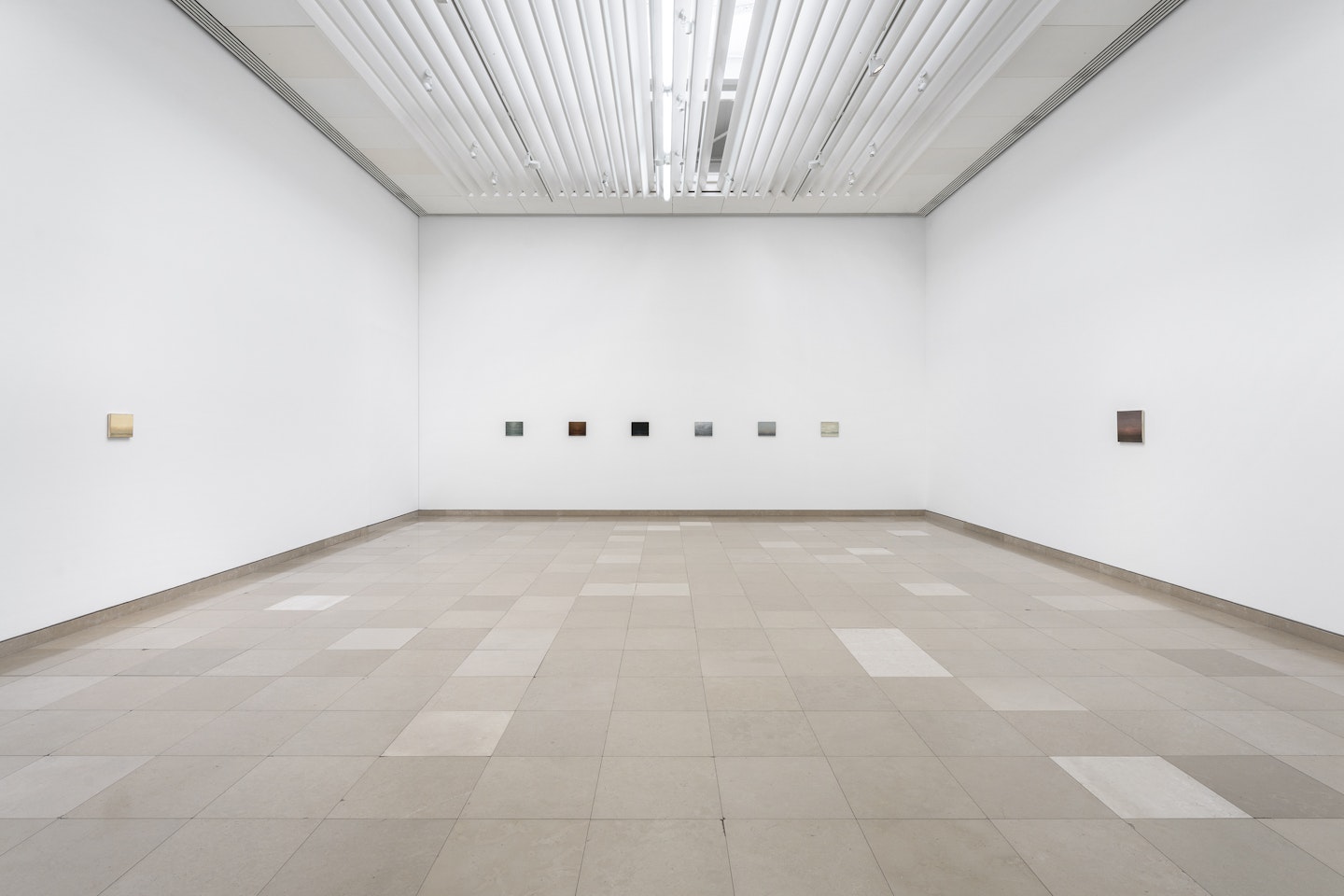
This anthological exhibition, entitled Deserto-Modelo, comprises more than forty works, bringing together some of Arruda’s most notable paintings alongside his experimentation with other media. This selection offers the public a broad and profound vision of his oeuvre as it has developed over the past two decades. The title functions as a conceptual tool the artist used repeatedly throughout his trajectory—both to name solo shows and an ongoing series of untitled works. The term is as evocative as it is enigmatic: Arruda invokes the image of an empty terrain in order to use it as an elemental space—the archetype of what exists beyond the boundaries of a landscape.
The notion of the desert carries an array of symbolic connotations—echoing biblical narratives of survival and transcendence, the stories of mirages betraying the eyes of the wandering travelers, and the silent expanses of cinematic wastelands. The artist employs this uninhabited, arid area as his fundamental model—a prototype of sorts, an essential matrix from which all else derives. He has spoken of this idea as an experimental ground, a conceptual, boundless space, with no beginning nor end, with no sign of biological life, absent of human traces, free from the grip of culture. A site that exists in the final frontiers of visual phenomena, and thus cannot be defined by the language apparatus.
The approach finds inspiration in João Cabral de Melo Neto’s (3) poetic vision, more specifically, from a stanza that speaks of a city being emptied out, “where engineers, armed with blessed projects, managed to build an entire model desert.” (4) To Arruda, this hollow place serves as a blank canvas where even the smallest gesture resonates profoundly. In another poem (5), João Cabral de Melo Neto likens the desert to a grove cultivated in reverse—an environment where things do not flourish but evaporate. In this inversion, absence becomes the rule, hunger replaces the fruit, and the form of the void takes the place of words. Arruda’s compositions reflect a similar tension, giving structure to the boundaries of emptiness, lending it a possible body, and holding the viewer in a space of perpetual oscillation. The landscape is then not a subject, but rather a medium for reflection—a conduit through which contemplation can propel us into something deeper, beyond the visible.
Rather than marking the apex of a trajectory or a conclusive statement, as one should expect from an exhibition, the recurring title emphasizes continuity and the repetition of inquiry. This tenacious recurrence aggregates meaning, in a never-ending process of symbolic stratification. Each work named “Sem título” (Untitled) affirms that what we see are timeless mental places. Imaginary nowhere lands. No more than “desertos modelos”.
3. Trembling Landscapes
At the core of Lucas Arruda’s practice are his small-format oil paintings—dense, charged, imbued with a mystical aura. Created from an amalgamation of recollections and intuition, these works channel the tradition of landscape painting, although not as mere representations of the world, but as atmospheric phantasmagorias over and above the faculty of vision. Through captivating, frontal depictions of fog, rainfalls, coastal scenes, spirited jungles and the trembling transitions of dawn and dusk, Arruda proposes a heightened sensorial experience. Based upon shivering horizontal lines, on the verge of figuration, his landscapes seem to hover in temporal suspension, as nature reveals itself not as a setting but as an existential force continuously transmuting between states.
The compact scale of these works belies their monumental energy. Magnetic and compelling, each painting opens a portal, drowning the viewer, almost like a talisman, a concentrated vessel of universal sensations, reminiscent of ancient apotropaic objects believed to carry transcendent powers. The chromatic variations—at times dark and intense, at others vibrant or subdued—are always extreme in their dramatic appeal, extending an invitation to immersion. They demand proximity, pulling the viewer into their layered depth, only to shift and disperse upon closer examination, revealing the physicality of paint itself, the traces of strong gestures, and the luminous interplay between opacity, shadow and glow.
His motifs are chosen for their capability to inspire awe, tapping into the human confrontation with nature’s vastness. These paintings inhabit the blurred zone between the longing for revelation and a melancholic nostalgia—to a point of desolation—synthesizing the paradox of human existence. If we are magnetically driven by nature’s overwhelming grandiose, each gaze upon this world can only reinforce our insignificance, a dire reminder of our genesis, and of what we have lost after the fall from paradise.
Arruda’s work inevitably echoes the legacy of landscape painting, from its historical documentary role to its poetic transformation in the hands of the Romantics. His sentimental paintings resonate squarely with the ethos of Sturm und Drang (Storm and Stress), a movement that sought to give violent expression to complex emotions, prioritizing raw subjectivity over rational order. Through his stunning renderings, the artist reimagines Romanticism’s fixation with the sublime, confronting the viewer with the instability and unfathomable enigma of the natural world. Yet, it is with the Impressionists that Arruda’s practice finds an even more intimate resonance, given their pursuit of nature’s impermanence—its constant dissolution and reformation under the forces of light. Nonetheless, if the Impressionists endeavored to seize the atmosphere of evanescent moments, Arruda takes this even further, not by registering specific pieces of the planet, but by dissolving its mass into a mental projection through brushstrokes that turn forms into sensations.
Arruda’s treatment of light and movement recalls great artists from these historical movements, however, his works conduct a major recalibration of landscape painting through the luminescence of the tropics. The everyday experiences under the intense, relentless sunlight, and the vibrant hues of the lush environment greatly impact the spirit of his paintings. This energy infuses his pieces with a luminosity and warmth that distinguish them from European imagery. While his work may evoke the classics, it ultimately reveals itself as something entirely distinct. In spite of clear visual approximations, he uses the social constructions of nature and landscape as contemporary frameworks to transliterate emotional states—most often impregnated with the density of the tropics. His paintings reify a morphological accumulation of experiences and musings, becoming the means of manifesting internal fluxes.
4. Meta-images, or the Ethereal Ground
In his mid-format monochromes, Arruda delves further into atmospheric exercises and the pursuit of the ethereal. Their origin lies in the very skies depicted in the small landscapes, from the observation of their relation to the raw background of the paintings. Their development happened gradually, from continuous experimentation: through a process of layering paint mixed with beeswax, Arruda creates a cold encaustic surface that absorbs rather than reflects light, resulting in a dulled, near-velvety glow. If contemplated long enough, these volatile fields begin to quiver, inducing hypnotic oscillations between form and formlessness.
Within these deep color fields, his brushwork dissipates into uncontrolled, evasive, vaporous spreads of pigment, creating a world that seems to be veiled in a heavy, mysterious fog. It is, indeed, not difficult to relate them to the endeavors of abstraction expressionism in its minimal manifestations. Nevertheless, in their spectral, almost cinematic quality, these works are more akin to the way Russian filmmaker Andrei Tarkovsky (6) uses nebulosity and diffused light to attain uncanny atmospheres. In their radical liminality, these paintings offer a thrilling experience between opaqueness and what lies behind it.
If his small landscapes bring forth the forces of nature, these monochromes move into the domain of the immaterial. They seem to visually synthesize the fundamental alchemic law, echoing the maxim of Hermes Trismegistus in The Emerald Tablet: “That which is below is like that which is above, and that which is above is like that which is below, to accomplish the miracles of the One Thing.” The land reflects the sky, the earthly realm mirrors the heavens, the body encapsulates the spirit. These paintings frame a metaphysical territory where the horizon emerges in its essential qualities—as a mere suggestion of division. In them, Arruda establishes the most reduced conditions for an image to appear, as if these works are related to a primal stage, performing either the genesis of things or the final disintegration of all forms.
5. The Spectrum of the Phenomenon
In Three Days and Three Nights (2023) Arruda orchestrates a dramatic, intricate interplay between materiality and spectrality. The piece consists of 81 hand-painted slides projected onto the wall, displaying images that exist solely through light and yet carry an undeniable physicality. What we see are not the slides themselves but their luminous revelations—phantoms that manifest through a mechanical, serial ritual of projection, each moment an ephemeral unveiling before escaping into darkness.
The slides, categorized into variations of daylight and nightfall, function as an elemental inventory of atmospheric phenomena and ever-shifting landscapes. Arruda paints them on acetate, embracing the unpredictability of the medium, with minute incisions and loose brushstrokes that expand into vast gestures when illuminated. Frantic—almost chaotic—, the images recall the liquid substance and effervescent dynamics of the primordial broth, in which the vital impulse runs freely before it turns into shapes. Through the combination of the material weight of color and the sheer immateriality of its projection, this cinematic sequencing highlights the passage of time and the choleric transfiguration of matter.
6. In the Blink of an Eye
Arruda continues his investigations of the equilibrium between the immaterial and the corporeal in his light work. In this piece, a square of projected light stands above a painted square on the wall. Their symbiotic relationship creates a subtle, intriguing juxtaposition. The entanglement between light and pigment generates a fragile tension: in their diluted formal manifestation, the twin squares are presented as different bodies, while connected in a nuanced fusion, prompting an enigma tied to the embodiment of light.
The artist has referred to this work as an “ideogram of landscape”, a minimal symbol, an abstraction distilled into its most elemental components to indicate a vision of the horizon. The upper square represents the sky—the realm of the ethereal, the imagined, the transcendental—while the lower square anchors itself in the earth, the material, the physical. The balance between the two, finely attuned to the tonal subtleties of the surrounding wall, invites the viewer into a moment of quiet revelation, as the work resists immediacy and demands prolonged observation. At first, it nearly fades; then, gradually, the eye adjusts, and its spectral presence is made perceptible, as well as the delicate difference of the quadrants. At this exact point, the artist finds a utopian equilibrium between reality and immateriality.
7. The Deposition of Matter
Finally, Arruda’s only video work, Neutral Corner (2018), proposes the dramatic witnessing of a fatal episode. The piece is a result of the fragmenting, slowing, and reordering of archival footage from the 1962 fight between Emile Griffith and Benny “Kid” Paret, whose final moments in the ring would mark a tragic, irreversible transition. Through a sensitive editing process, the work shifts away from the brutality of the spectacle to focus on the moment of collapse and decay. The body succumbs; stripped of its last drop of vitality, it descends onto the canvas, ultimately yielding to gravity.
The video studies the anatomy of the decline as a sublime act of passage, establishing a direct affiliation with the biblical narrative of The Deposition, and its vast exploration as a motif in the history of painting. The lowering of Christ’s body, the weight of flesh against grieving hands, the liminality between earthly suffering and transcendence—all is present in Arruda’s reworked footage. Here, matter decants, the vital force abandons its corporified incarnation, and the spirit ascends. In its dramatization of the cycle of life and death, Neutral Corner contemplates the essential impermanence of all things in a morbid dance between that which remains and that which vanishes.
8. Void, Transcendence and Continuation
In the center of one of the exhibition rooms there is a tridimensional object, a small vessel—a replica of an Egyptian alabaster cup that Arruda once saw displayed in a museum. It stands alone as a synthesis that embodies the paradox at the core of his practice: the attempt to give contours to the void. The effect of the light being filtered through the translucency of the mineral also recalls the veiled luminosity that defines his works. Hence, this airy object encompasses the incandescence of the small paintings, the boundless color fields of the monochromes, the phantasmagoria of the slides, the tenuous limits of the light installation, the weightless fall in the video—all holding within them the aspiration to transcend from the confines of matter.
Through his methodical, obstinate devotion to the study of light as the ultimate mediator of reality, Arruda constructs electrifying, enchanting images that vibrate between consolidation and disappearance. Always in motion—resisting conclusion—his oneiric, misty episodes are portals to inner dimensions. As emblems of the radiation of energy in the world, they investigate how we absorb our surroundings and, in turn, are reshaped by them. In this journey of perception, we dare to move from darkness to clarity, and from clarity to darkness, surrendering to an endless flow of discovery and transformation.
(1) The title of the book has been translated into English in different ways, such as The Sad End of Policarpo Quaresma and The Decline and Fall of Policapo Quaresma.
(2) Born Afonso Henriques de Lima Barreto (Rio de Janeiro, 13 May, 1881–Rio de Janeiro, 1 November, 1922), Lima Barreto was a Brazilian novelist and journalist, and a major figure related to Brazilian Pre-Modernism.
(3) João Cabral de Melo Neto (Recife, January 6, 1920–Rio de Janeiro, October 9, 1999) was a Brazilian diplomat and poet, deeply influential in late Brazilian Modernism.
(4) Medinaceli, 1955
(5) Psicologia da composição (Parte VIII), 1947
(6) Andrei Tarkovsky (Zavrazhye, April 4, 1932–Paris, December 29, 1986) was a Russian filmmaker and screenwriter, acclaimed for his meditative, metaphysical films, which have had a profound influence on contemporary cinematic aesthetics.