Ultratremor
2026
Germano Dushá is a curator, writer, and cultural agent with a law degree (FGV Direito SP) and a postgraduate degree in Art: Criticism and Curatorship (PUC-SP). At the intersection of aesthetics, critical thinking, and esoteric traditions, his practice assumes multiple forms—as curatorial, literary, and hypermedia experiments—to investigate social imaginaries, and to dwell on the energy fluxes connected to radical subjective experiences and transmutation processes.
Contact germano@ofora.org


The Essence of All and the Machinery of Worlds (1)
Amidst an unfathomable darkness, a single luminous point emerges. Its light vibrates revealing a dynamic cascade of colors, as if a single circle could unfold into countless others through a sensitive symmetry, probing the nuances of its own existence. At the core of this spheroidal star, an inverted triangle takes form, standing out as a central mark, through a stark chromatic contrast. Whether it be a transcendental vision, a celestial phenomenon, or a mathematical construct is irrelevant; what matters is the vitality of this celestial body, constantly in motion, in a state of perpetual metamorphosis, shifting with every passing second.
Variations of this same image, with differing geometric arrangements and combinations of colors and textures, appear across countless paintings by Montez Magno. These works comprise the extensive Tantra series, which has intermittently accompanied much of the artist’s career. This intricate and multifaceted collection stands as the pinnacle of his metaphysical exercises, driven by his spiritual resonance and profound inquiries into the mysteries of existence.
As is often said, whatever we seek is also seeking us, and when the time is right, an intersection naturally takes place. So it was in 1972, in the city of Olinda, where Montez Magno resided at the time, when he was introduced to the path of Tantric art through two authors whose books found their way into his hands: the Indian Ajit Mookerjee—who devoted his life to the study and practice of tantric principles—and Philip Rawson, a prolific British writer and specialist in Eastern, particularly Indian art. A voracious reader whose intellectual curiosity spanned a wide range of subjects and disciplines, Montez Magno immediately felt a connection, drawn by the compelling concepts, the vibrant energy, and the adaptable nature of tantric art. The principle of this system resonated with his own artistic practice, which had begun nearly two decades earlier and had always blended a variety of conceptual frameworks, materials, and techniques. From that moment on, he delved into this knowledge, which would become a vital and artistic foundation for the rest of his life.
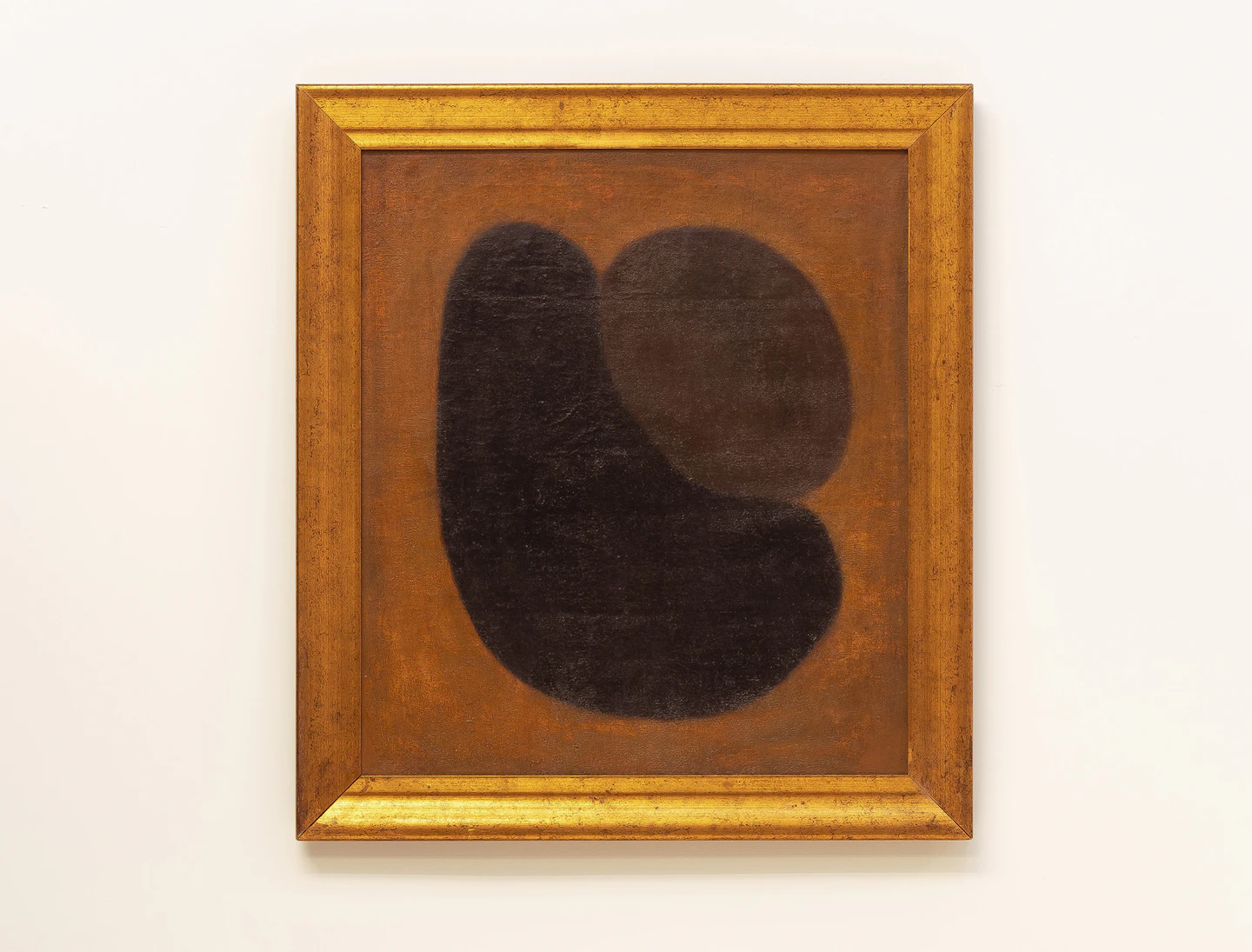
The strength of this connection was so profound that even works predating this encounter were formally incorporated into the series, as they already embodied similar themes, albeit approached from different perspectives. Such is the case with the Negra (Black) series, whose earliest works emerged in the early 1960s and continued through 2007. In these paintings, the essence of the plant kingdom provides a foundation for contemplating the void in motion and the genesis of forms. By working with images of tree trunks that are gradually reduced to their essential state, the artist transitions from botany to phenomenology in his exploration of the underlying substance of these figures. What manifests are specters in expansion and states of expansion and contraction, punctuated by negative, hollow points. These amorphous masses, pierced by points of light, reveal themselves in open metamorphosis, shaped by diverse vectors. Constantly in flux, it is as if a fragment of matter—cosmic or cellular—were being stretched in multiple directions, shaping itself within the bounds of the canvas.
In a subsequent phase, the process of reduction intensifies, reaching a new synthesis. The trunks are simplified into rounded forms that interlock smoothly, revealing what resemble dark fruits, like fragments of organic matter suspended in the vastness. In its final evolution, the Negra series undergoes a complete abstraction; in place of the trunks and fruits, only a dark stain remains, erupting like an existential rupture, intense and mysterious. It is a spectral apparition, probing its own formal boundaries. At last we encounter the essence of the vital phenomenon. In the contrast between light and shadow lies the void, the negative space emerging from within, evoking enigma and inviting a plunge into the depths of darkness. This void, however, is never depletion. It is pure potential, the void as genesis, a principle for new beginnings.
In the early part of the next decade, upon encountering tantric art, Montez Magno was profoundly transformed by its influence. This process gave rise to a new body of work, a continuous flow of creations that extended into the mid-2000s. Known as the Tantra series, this body of work can be considered one of his most significant accomplishments, the very core of his vast and multifaceted oeuvre. Perhaps this encounter was less a discovery and more a reunion, as if, in this incarnation, the artist was merely reclaiming something already inherent to him. Although Montez Magno acknowledged the inescapable, foundational impact of his environment, believing firmly that the roots of his art lay in his childhood and youth experiences, he also embraced the mystical, spiritual dimension that transcends material, regional, and cultural boundaries. This may explain his profound connection to India and the sense of rapture he experienced when encountering a culture from the other side of the world.
Tantra is an esoteric tradition that arose in ancient times, evolving in India and nearby regions, profoundly influencing the foundations of Hinduism, Buddhism, and, to a lesser extent, other religions. Although no simple definition can fully capture the profound essence of this multifaceted spiritual and philosophical tradition, at the heart of the Tantra lies an ecstatic worship centered on a vision of cosmic sexuality.(2) In this regard, Tantra encompasses beliefs, teachings, and practices relevant to all aspects of life, ultimately directed toward spiritual elevation through an understanding of cosmic unity and, thereby, the interconnectedness of all beings and phenomena.
This transcendental vision and pursuit are reflected in a complex ensemble of myths, rituals, and symbols. Beyond the sacred texts that compile the foundations of these understandings—also called Tantras—countless visual forms are associated with tantric practices. These images embody ideas rooted in Indian’s ancient spiritual foundations, elaborating on these elements through personifications and diagrams.(3) Tantric art, therefore, refers to the aesthetic universe and visual expressions that emerged alongside the development of Tantrism over millennia, reflecting its spiritual aspirations and philosophical principles while also providing tools for its more practical applications. The tantric tradition has intricately mapped out the mechanisms of energy currents by which the cosmic creative impulse manifests in the human body and the universe. In both its texts and artistic canon, Tantra reveals the dynamics of this vital system, offering detailed guidance to help individuals engage with these processes more effectively.(4)
In his immersion in Tantra, Montez Magno primarily drew from the concept of mandalas, circular diagrams that represent—or embody—the concentration of cosmic energy. These cosmograms typically feature complex patterns and intricate layers, inhabited by diverse elements whose representations span from organic nature to deities, and may include mantras and sacred inscriptions, referencing universal phenomena across various levels and dimensions. In tantric symbolism, the mandala serves as a representation of the cosmos itself, used in rituals and meditation practices. In this context, both the creation and contemplation of the mandala function as tools for fostering enlightenment and spiritual realization.
Under Montez Magno’s hands, free experimentation with the metaphysical and visual principles of this tradition yielded unique variations, providing a distinctive interpretation of its foundations. Rather than intricate patterns, symbolic multiplicity, figures, and fine details, the artist employed an intentional economy of forms, focusing on the essence of tantric mandalas. In his paintings, energetic diagrams are composed of basic, flat shapes, schematically arranged in concentric formations. Through a broad chromatic spectrum, circles, squares, and rectangles emerge to form compositions that, in a distilled manner, express the creative flows that shape and expand the universe. These paintings generate mental schemas, embodying ideas of motion and expansion as well as unity and interconnectedness, evoking a spectrum of sensations and emotions.
These works often feature the artist’s interpretations of important symbols, such as the inverted triangle, symbolizing the yoni— a Sanskrit term for the female genital organs that can also be understood as the "cosmic womb"—an emblem of feminine creative energy. Within the Tantra series, a subdivision emerges centered around the lingam, another significant icon in tantric tradition. The lingam, meaning "sign" or "symbol" in Sanskrit, is an oval shape serving as an abstract representation of the phallus and, by extension, of masculine creative energy that fertilizes and expands life. It can also represent Shiva(5), embodying his divine potential. This symbol is traditionally used in votive images and objects for rituals of devotion or meditative practices. In Montez Magno’s paintings, the lingam appears in varied forms. Each manifestation of this cylindrical shape reveals nuanced geometry, containing references to diverse materials, ranging from earth and bamboo to undefined textures. By placing the lingam in high contrast against backgrounds that vary in solidity, the artist allows the form to hover in an idealized space, accentuating its mystical nature. These symbols become like talismans or energy portals, radiating the universe’s generative force.
The series also includes object-based works that seem to act as material and tactile foundations. For example, Mesa Tantra (Tantra Table, 1972/1977) brings together various objects arranged in a strict, diagrammatic fashion, organized like instruments for spiritual improvement practices. Another work, is Santuário Tantra (Tantra Shrine, 1973), a substantial piece of furniture with niches and shelves holding stones, icons, and other materials, resembling a blend of a devotional altar and a tool cabinet. These works highlight Montez Magno's interest in the relationship between the esoteric realm and the tangible, material world.
Throughout the decades in which the Tantra series evolved, Montez Magno also pursued metaphysical explorations in painting along other paths. In the 1980s, for example, with the series Portas de Contemplação (also referred to as Gates or Porticos ‘of Contemplation’), the artist returned to a more restrained pictorial approach to address expansive themes. Composed in somber tones and limited colors, these paintings revisit geometric abstraction, infused with symbolic meaning and intense atmosphere. Blocks emerge, filling the entire canvas with a commanding verticality. The composition is further distinguished by a wide band slicing across the center of the canvas, suggesting movement between two pivoting sections, thereby evoking the impression of grand portals. While hinting at the possibility of accessing what lies behind—whether ancient secrets, hidden chambers, sacred spaces, or entire cities—these enigmatic gates also stand as dense barriers, intended to be traversed only by those initiated into their mysteries.
Years later, between 1992 and 1998, Montez Magno would create the Branca (White) series, a kind of counterpoint to the Negra (Black) series, thereby completing a cycle in his metaphysical art journey. The inclination toward total reduction or the annihilation of form remains, as does the geometric and chromatic experimentation used to sublimate matter. The series is grounded in a play of low contrast, sometimes minimal, as a counterpoint to the chromatic and geometric richness of the Tantra series. However, given that white’s existential nature is the combination of all visible colors, it embodies total potential—a condensation of all hues and tones. Although latent, this stored potential always suggests the capacity for the revelation of new possibilities. In the pictorial development of these works, Montez Magno juxtaposes white with other colors, subtly illuminating and enhancing their qualities. When blended with red, shades of pink emerge; when blended with black, shades of gray appear, and so on. Even light and subtle, these touches resonate across the canvas, evoking intense sensations and a state of continuous transmutation.
The square then emerges as an echo of the canvas itself, a meta-reproduction of its frame, which in turn generates smaller replicas. These quadrilateral and concentric forms appear gently, often hazy, like mist. They accumulate within each other in an eternal, rhythmic movement of expansion. In this series, Montez Magno intentionally adopts small dimensions, as if inviting the viewer to come closer and engage in an intimate connection with the artwork, aiming to inspire an active, prolonged, and profound contemplation. With these liminal paintings, whose images ebb and flow on the verge of revelation, the artist's intention is to offer a magnetic piece under which the observer can interact actively on all levels: physical, mental, and spiritual. By engaging the senses and immersing in the object, the viewer is invited not only to experience its evoked sensations but also to gain understanding, accessing its inner mystery.
Confident in the power of art to transcend and elevate us to other planes, Montez Magno infused his practice with the principles of esoteric traditions and spiritual rites. It is said that on one occasion, he was seen in silence, immersed in thought. When asked what he was doing, he did not hesitate: "I am working." But how could one work without a pencil, brush, or any material in hand? "I am working here", he replied, tapping his index finger against his temple.(6) Working on the movements of the mind in relation to existential conditions, reflecting on the primordial nature of things, was the guiding thread of his work. Like one who creates to explore the self and the world, the artist sought in earthly objects and images a connection with a greater dimension. His creations are exercises in connecting with the universe's creative impulse; with the nameless, infinite, and ineffable energy; with the living soul that permeates everything, that animates all, which is the force of life, the driving force of the world.
(1) Reference to the poem Tudo o que se vê é tudo e não é nada (Everything We See Is Everything and Nothing), from 2002, by Montez Magno, which reads: “There is an internal movement we do not see,/ unrelated and superior to all we know/ exists around us, which astonishes us:/ I am not certain what it is, but I suspect/ that within the core of being, at its sacred altar,/ there lies a motor, the machine of the world,/ (…) But whoever enters the interior of things/ will perceive that atoms are always opening,/ that the soul of all things is also living matter,/ that the formless spirit is concealed force,/ everything we see is everything and nothing.”
(2) RAWSON, Philip. The Art of Tantra. Londres: Thames and Hudson, 1995.
(3) IDEM
(4) IDEM
(5) One of the main deities in Hinduism, Shiva represents the destructive and regenerative aspect of vital energy and is commonly associated with the masculine principle.
(6) Account given to the author by Itamar Morgado.