Ultratremor
2026
Germano Dushá is a curator, writer, and cultural agent with a law degree (FGV Direito SP) and a postgraduate degree in Art: Criticism and Curatorship (PUC-SP). At the intersection of aesthetics, critical thinking, and esoteric traditions, his practice assumes multiple forms—as curatorial, literary, and hypermedia experiments—to investigate social imaginaries, and to dwell on the energy fluxes connected to radical subjective experiences and transmutation processes.
Contact germano@ofora.org
The Many Ways of Being in the World
Forces erupt into space like a choreography of drives and aspirations. The energy that holds things together, splitting light into spectra, governing the flows of matter, giving body to substance, declares itself through infinite forms. Spheres suspended in air, chromatic grids blooming and spilling from the wall, dynamic schemes for a spiritual geometry in its countless possible arrangements. In Lygia Pape’s work we encounter this vital principle directly: everything that gains form in the world is the expression of an intelligence that seeks, without rest, new ways of being.
Sendo, the title of this exhibition, references one of her Poemas Luz (1956 – 1957), in which coloured, translucent acrylic panels float and juxtapose in space. Across one of these planes, the word sendo (being) is inscribed, traversed by light. The present participle is precise: action in process, a continuous state, something that never resolves. It is the synthesis of a body of work that never stood still. As the critic Guy Brett consistently observed, borrowing a formulation from Hélio Oiticica, Pape’s work operates as “a permanently open seed,” an expanding vector that, with each new advance, reasserts its capacity to generate new ways of being. This unstoppable openness is not dispersal but deep coherence, the product of an artistic vision for which radical experimentation was an existential condition.
Few artists have held such plurality together within a body of work so unified. At every turn, formal rigour and free intuition, poles that could cancel each other out, arrive at a vibrant equilibrium. Abstract geometry and arithmetic precision meet a tropical sensibility and gestural autonomy, opening onto the multiple possibilities of an idea becoming a visible phenomenon. Underlying it all is an extraordinary communicative faculty. Surfaces, folds, juxtapositions, contrasts, and optical games emerge with an elegant simplicity that does not reduce complexity but reinforces it, holding the balance between mathematics and whatever escapes calculation.
This potency runs through the full arc of Pape’s career. The exhibition spans five decades of production, from a rare 1953 painting made the year the Grupo Frente was founded, to works from 2003, a year before her death. Already in that seminal canvas, produced at the earliest moment of the concrete movement in Rio de Janeiro, one finds the free energetic flow, the effervescence of forms, and the urgency of gesture that would, within a few years, drive the neoconcrete experience in its resistance to the prescriptive rigidity of Concretism. The late works, at the other end, testify to a relentless journey, and to an ingenuity that never stopped reinventing itself. Together they trace a practice of continuous unfolding that never lost its original force, and that stands as one of the decisive markers in the passage from Modernism to contemporary art.
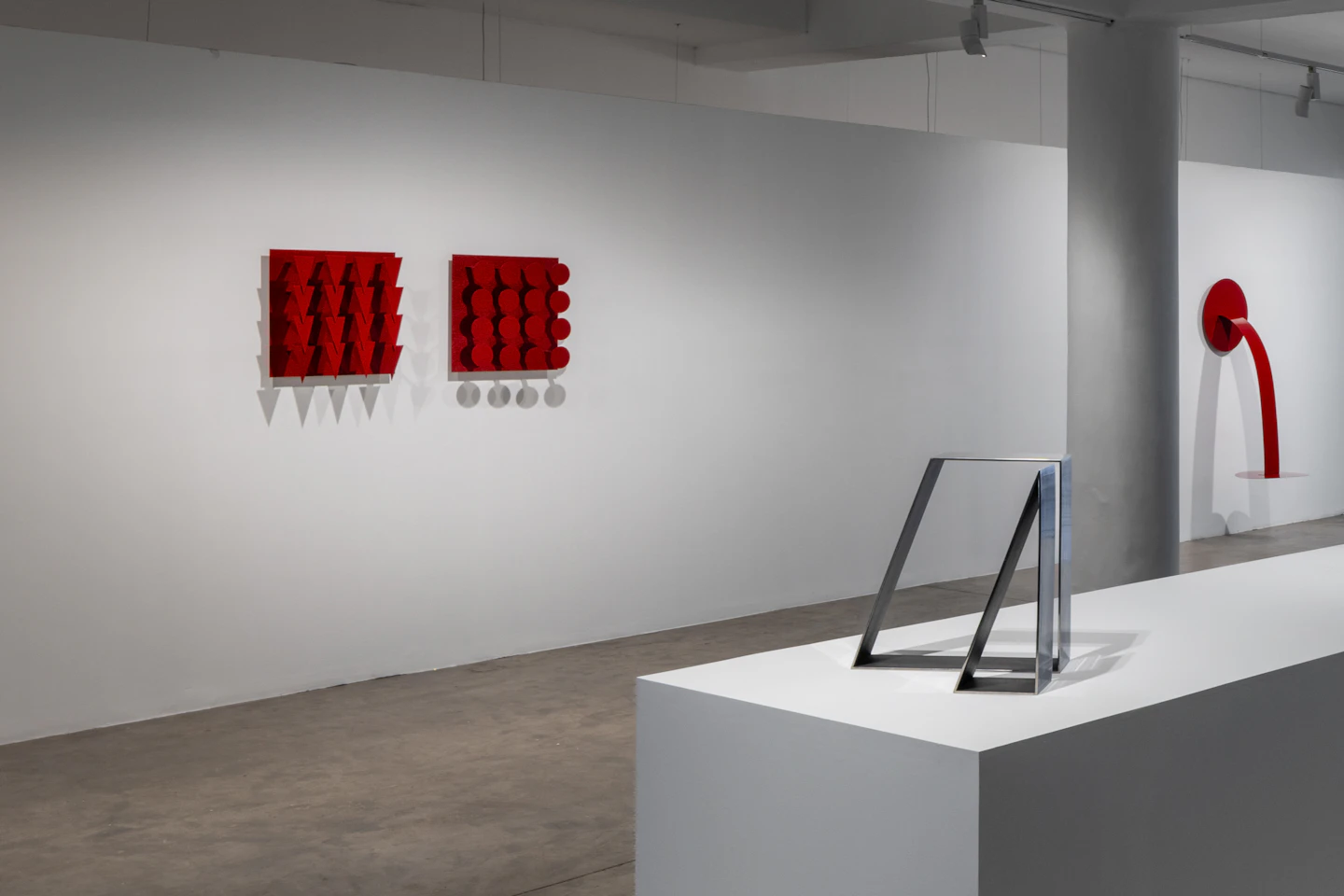
The series punctuating this trajectory function as nuclei of investigation, sites to which the artist returned again and again, always by renewed means. In the woodcut Tecelares (1957 – 1959) series, geometric intention meets its limit in the organic grain of the wooden matrix, producing compositions that recall the spatial negotiations of tectonic plates: two-dimensional exercises that would later feed her three-dimensional work. In the variations of Livro Noite e Dia I (1963/1976) and Livro do Tempo (1965), Pape builds narratives through reliefs and volumes that strain against the plane, subverting the square through combinations that resist any linear reading of light and time. The KV series (1961/1998), executed in stainless steel, uses reflective surface and interlocking form to shift the work into a different register of sensation entirely. These pieces enter the world as elements of an alphabet, formal units ready to be articulated into semantic structures that written language itself may be unable to fully hold. Abstraction here is not a narrowing but an expansion of the artist’s iconographic reach: forms are freed to say more than any figuration or phrase could manage.
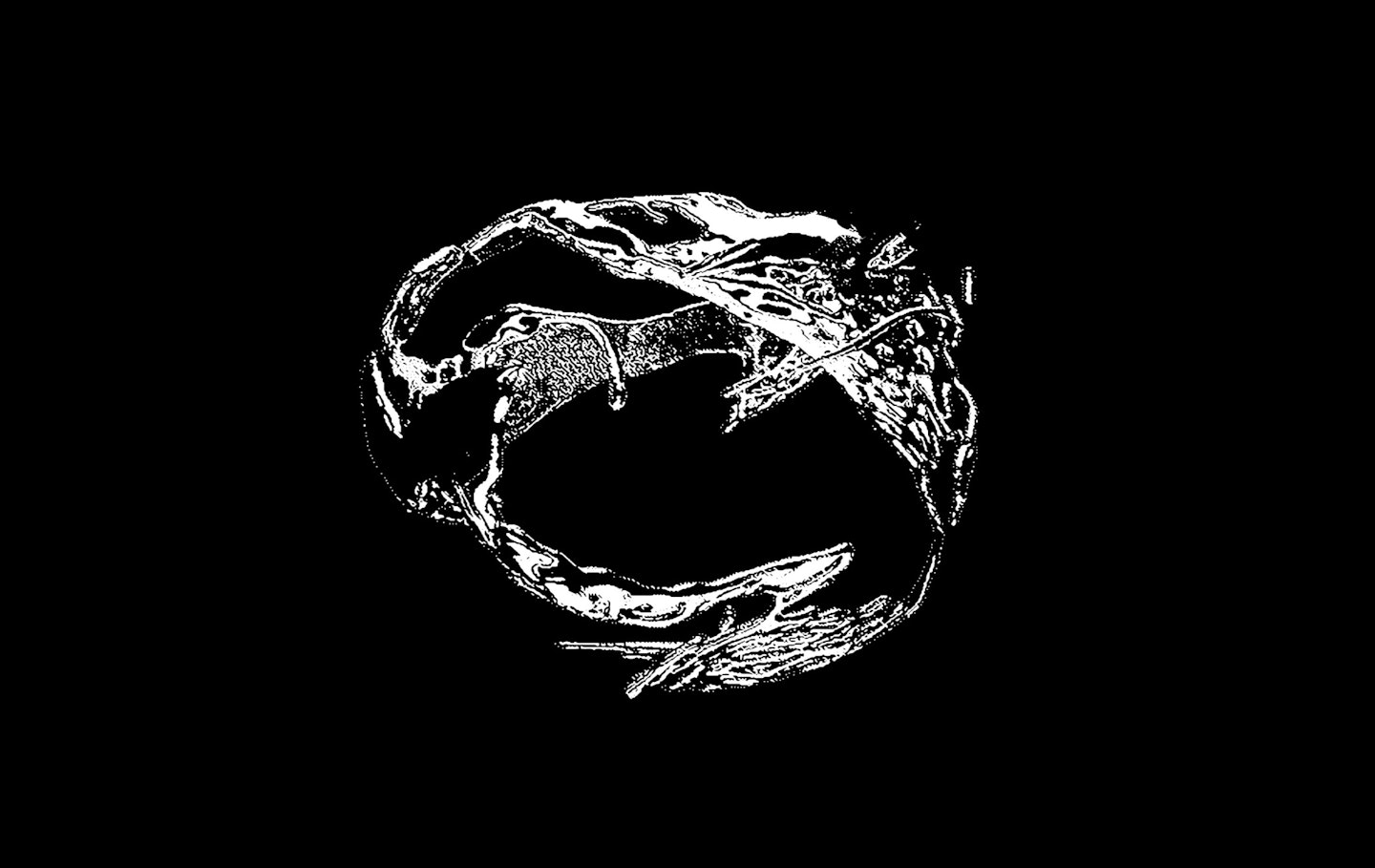
In Ttéia 1, B (2000), silver threads arranged in spheroidal formations trace cylindrical volumes suspended between materiality and pure luminosity, an architecture of light that arrives as transcendental apparition. Ttéia nº 7 (1991) takes a different approach: a dark, immersive enclosure in which two pyramids coated in blue pigment rest on square white fabrics, two beams of blue light the sole source of illumination. It is as though immaterial light has been turned to dust, concentrating the energy of the space and fundamentally reorienting sensory perception. Both works are ways of weaving space, situations that echo the experiences Pape recorded wandering the streets, alleyways, and tunnels of the city. In the Amazonino Vermelho (1989/2003) and Amazonino Verde (1989) series, iron structures thrust from the walls with captivating urgency, evoking animal viscera, plant shoots, air bubbles, waterfalls. Esferas (2001), rare, scarcely exhibited works, complete this lexicon with a presence that dissolves the boundary between object and environment. They read as instruments of power from another time, opening their interiors to the world and revealing, through organic apertures, absolute black: a primordial void, the sign of total possibility. Rhythm, gradation, layering, contrast, texture: across painting, drawing, sculpture, and installation alike, we encounter an artist who translated sensation and emotion directly into matter, and who understood form as a living organism in permanent mutation.
Distributed between Casa Iramaia and the Barra Funda warehouse, the exhibition unfolds across two distinct moments with complementary atmospheres. Rather than a retrospective survey, it proposes the activation of a relational system, the energetic invocations of each work brought into dialogue with the others. Placing canonical pieces alongside rarely seen works, the whole makes clear that Pape’s strength lies not in formal consistency or any representational agenda, but in the persistence of a single impulse: to invent new ways of knowing the world. The exhibition reaffirms the significance of an artist whose pioneering spirit made freedom and experimentation into both method and ethos, irreversibly expanding what art might be.
Lygia Pape’s work draws you in and envelops you until it consumes you entirely. Less a treatise on a particular subject than an inquiry into the many ways of approaching a subject, her oeuvre is about the inexhaustible power of art to give form to what has not yet been named, and ultimately about the many ways of being in the world. Those who allow themselves to be captured by it will not emerge unchanged. Having been consumed, they will come back into being differently, inevitably, and only ever: being.