Ultratremor
2026
Germano Dushá is a curator, writer, and cultural agent with a law degree (FGV Direito SP) and a postgraduate degree in Art: Criticism and Curatorship (PUC-SP). At the intersection of aesthetics, critical thinking, and esoteric traditions, his practice assumes multiple forms—as curatorial, literary, and hypermedia experiments—to investigate social imaginaries, and to dwell on the energy fluxes connected to radical subjective experiences and transmutation processes.
Contact germano@ofora.org
I. Metapainting and mutation
For Rodrigo Andrade, to paint is to call painting into question. Over the course of more than four decades, his practice has been built upon a dual motion: taking painting as a medium and, at the same time, as a problem, testing out its boundaries and questioning its very raison d’être. In his process, art history is not absorbed as a mere reference or fulcrum, but as living matter to be digested and then returned to the world in novel configurations. From vernacular to erudite, from expressionism to constructive rigor, from abstraction to figuration, everything gets metabolized with no prior hierarchy, as the substance of an oeuvre that refuses stability.
As such, one can speak of a metapainting — a painting that ponders itself as it unfolds and finds in the phenomenon of mutation both its method and its subject matter. However, if on the one hand the artist’s work entails radical openness and the voracious assimilation of numerous stimuli, on the other hand, its foundations persist, irrevocable. The loaded gesture, material density, thick layers of paint, and large chromatic blocks — at times splotches of color, at others graphic signs or recognizable figures — constitute an unmistakable diction in spite of all variations. Amid this trajectory of permanent renewal, the constant will remains to lend an outline to the forces — of order and chaos, of construction and dissolution — that drive life, as well as a commitment to exploring the historical statute of painting and its possibilities as a contemporary tool.
II. Matter, image, and sensation
In this new set of artworks, the impulse gets synthesized in a particular way. The paintings are born from the artist’s specific approach to dealing with paint and building images as a means to mobilize a material, sensorial, and subjective experimentation. Each artwork builds on certain compositional principles — a visual economy that defines spatial structuring, figure placement, and color relationships. However, the physical dimension of the raw material is juxtaposed onto those precepts, i.e., the weight and unpredictable behavior of the mass of paint upon the canvas. What ensues is a direct clash with chaotic materiality.
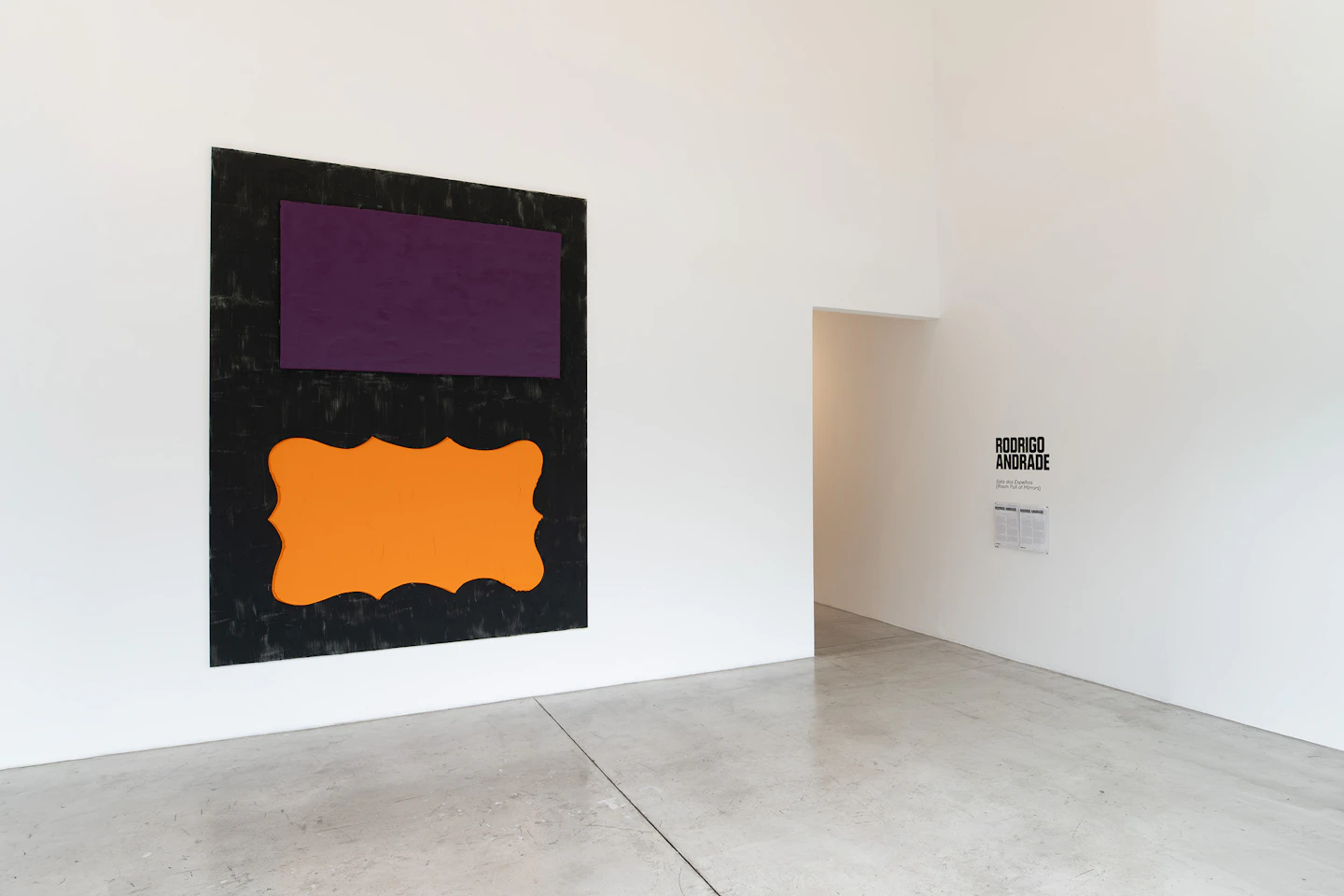
The artworks combine gestural frontality, chromatic intensity, and material density, building tension between body, image, and evocation. Volumes of paint leap from the surface like unstable bodies, imposing their physicality as they usher in atmospheres, imply narratives, and above all, trigger sensations through the combination of color and shape. Each erupting figure — and each chromatic outburst, each contrast — carries its own energy, which can redefine the composition’s entire ambience. If these paintings are battlegrounds between control and chance, the result is never the triumph of one over the other, but a third thing altogether: a tense, magnetic space where something seems to be about to happen. This imminent metamorphosis is what gives his works their strange vitality.
III. Game rooms full of reflections
The title of the exhibition references the HiJimi Hendrix song “Room Full of Mirrors,” evoking a setting saturated with reflections and possibilities: at once playful, disquieting, and oppressive. It harks back to a mental state of intense reflection and inescapable transformations. Andrade is interested in situating painting as an existential field, precisely over the thin line of this ambiguity: the room full of mirrors as a popular attraction, an image from common culture — somewhat vulgar, somewhat pop-like —, but also a room where the ordinary becomes disturbing, like the set of a psychological thriller.
Here we also have the game realm. This is a game of mirrors: a spatial game with set rules. The perspective, with its defined — and often central — vanishing points, creates an almost oppressive structure within the paintings, a strict visual order which the artist establishes and then combats. It is up to the matter and the figures that invade the canvas to fracture this visual hierarchy and redefine the logic of the composition, similar to how a chemical reagent alters the nature of a solution.
IV. Mirrors, caves, furniture, ghosts, and other allegories
Even as plurality of routes is an intrinsic condition to Andrade’s practice, in this group of paintings, one recognizes three avenues of visual synthesis. A first cluster features relatively deep interiors: liminal spaces populated by mirrors with sinuous frames, caves that open up on the walls, sofas, lamps, and other elements that oscillate between the familiar and the spectral. They are in a way reminiscent of scenes from a genre movie that finds immeasurable complexity in the most commonplace things. In a second cluster, the compositions turn more abstract and graphic, creating rooms whose walls are areas of color over which ornamental shapes float, stripped down to their graphic essence — signs that precede organized language, hybrids between drawing and living organism. And in a third group, dancing figures emerge, half-clowns, half-ghosts. They are organic silhouettes that multiply and mirror one another like masks in the middle of transfiguration. In none of these resolutions do the figures operate as decoration or illustration: they are active apparitions capable of ushering in new dynamics within the chambers they inhabit, like parts of an own vocabulary in continuous flux.
The scale underscores this potency: some paintings are up to roughly three meters tall or wide, carrying huge masses of paint that function as portals — openings that summon the viewer’s entire body. Other smaller paintings invite an intimate approach, revealing subtleties that are only unveiled from up close. Halfway between raw matter and subjectivity, between mass culture and art history, between the planarity of modern painting and the atmosphere of cinema, there emerge metaphysical environments, psychologically charged and inhabited by presences that destabilize the original arrangement that constitutes them. Like a room where everything reflects and goes across everything else, each painting opens up the possibility of our facing ourselves and, as a result, envisioning other ways to exist.