Ultratremor
2026
Germano Dushá is a curator, writer, and cultural agent with a law degree (FGV Direito SP) and a postgraduate degree in Art: Criticism and Curatorship (PUC-SP). At the intersection of aesthetics, critical thinking, and esoteric traditions, his practice assumes multiple forms—as curatorial, literary, and hypermedia experiments—to investigate social imaginaries, and to dwell on the energy fluxes connected to radical subjective experiences and transmutation processes.
Contact germano@ofora.org


Opening
There are states the mind traverses without ever naming. Transitional zones where waking consciousness dissolves into something else—something that eludes all language. At this unspeakable threshold, unbidden images arise, belonging neither to memory nor to deliberate invention. They seem, rather, to be intuited—signals captured by a mental antenna tuned to a frequency that everyday life obscures. Visions without declared origin, without recognizable identity. Presences without names.
It is this experience that Lucas Milano's paintings evoke. His compositions do not represent the world, nor do they offer personal confessions. Free from descriptive function or narrative intent, these apparitions are irreducibly non-referential. Light, texture, and chromatic scales create spatial principles and proto-bodies at the edge of visibility. The artist builds up successive layers of glaze, each translucent enough to reveal what lies beneath, so that depth is suggested less by spatial illusion than by the slow accumulation of material over time. Even so, everything manifests on an almost membranous surface—thin and fragile—whose animate pulsation prevents form from ever settling into definition. While this tremor draws the eye with a mixture of wonder and enchantment, what is seen is only a rarefied, nearly vaporous trace—something on the verge of materializing or beginning to dissolve. Within the tension of a magnetic mystery, atmospheres and emotional states emerge in a way that could not be conveyed by any other means, held as in a visual enigma.
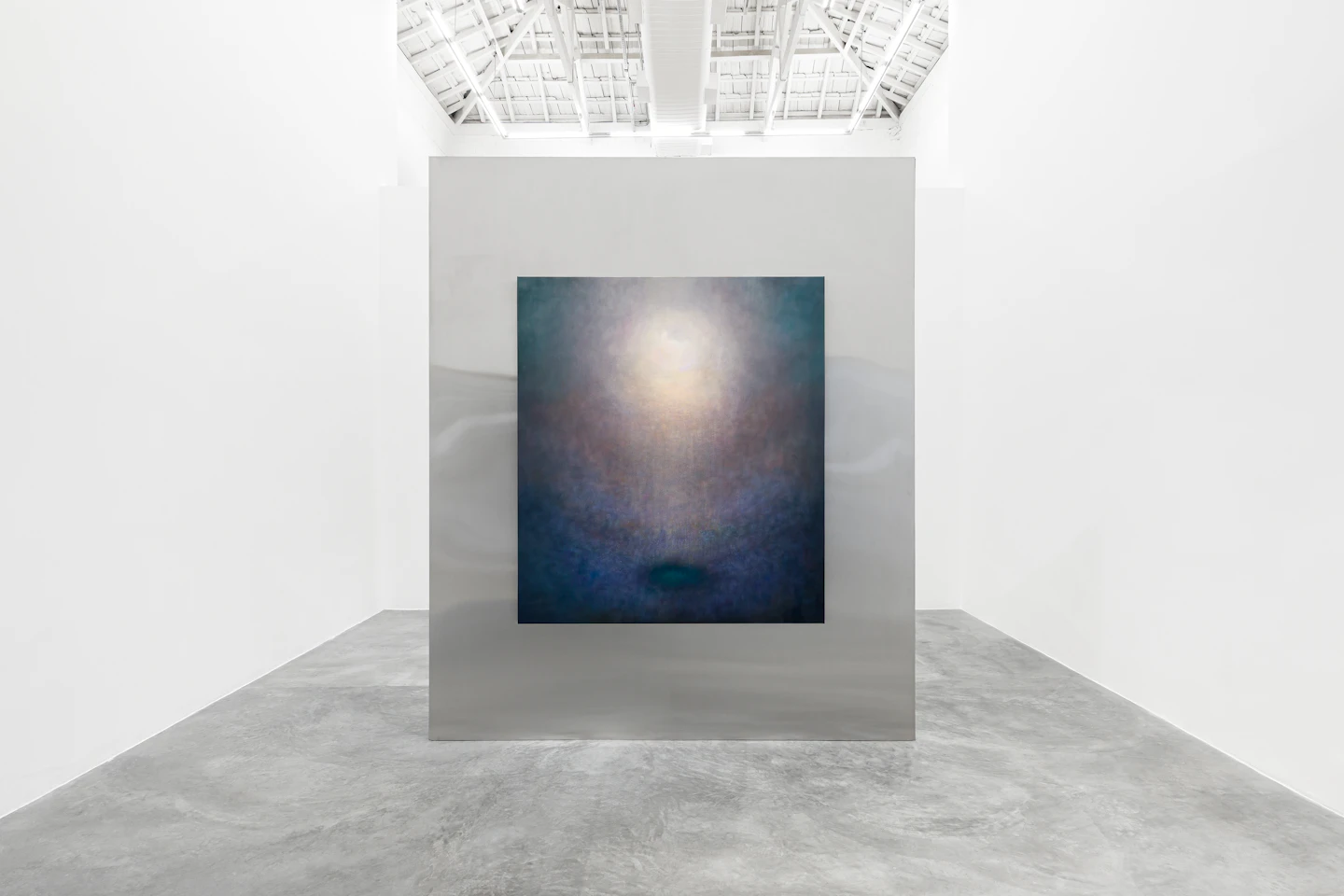
Vigília I
A spectral sphere blazes in a space that shifts from violet to anthracite gray. At the lower edge, a vortex of acidic colors breaks open like the Earth’s own eye: its abyssal depth counterbalances the glorious luminosity emanating from above, creating between these two poles a fateful equilibrium. Light is born, generating its own matter, in a radiance that subjects the surrounding space to the force of its gravity. The atmosphere recalls a planetary era long past—perhaps the time when halobacteria tinted the surface of the Earth in shades of purple—or the topography of another world.
The brushstrokes persist beneath the glazes, bearing witness to the image's own making even as it seems to dissolve. Each gesture remains alive among the countless layers of paint, preserved as an energetic trace running through the thickness of the painting. The cosmic dialectic between the incandescent core and its surrounding darkness brings opposites to the point where they become indistinguishable and interchangeable. We may witness, all at once, formation or collapse, genesis or apocalypse. This elemental drama repeats itself at different scales, moving vertiginously from the structure of an atom to the trail of a nebula, to the emergence of a black hole—or further still, beyond all of this, to a divine tear falling through the void of the Cosmos.
Vigília II
In the second apparition, the palette turns whitish and contrasts soften. Vertical forms are veiled by a dense mist: a phantasmagoric woodland filtering the light of a distant clearing, a rarefied astral forest, or a plain of prototaxites hundreds of millions of years ago. This verticality stretches from ground to sky without ever sharpening into focus, subtly marking the distance between what lies below and what lies above.
Rather than shine, light diffuses outward, radiating from the center toward the edges, which hold a soft ochre warmth. Here, the layers of glaze reach an extreme transparency, almost matte, accumulating into such delicate strata that the depth they construct seems to be of another nature—not spatial, but temporal. The vertical forms—tenuous and fleeting—persist like specters whose original configuration has been gradually obscured by successive events. In this way, the image recedes at the same rate as it advances, in an endless interplay between object and observer. The eye searches but finds nowhere to rest; perception wavers in a continuous and inescapable suspension.
Vigília III
Finally, an embryonic body of strange vitality emerges. Its acid and vibrant green erupts from an energetic impulse that seems to precede any discernible organism. Here, light behaves differently. It has no localized origin, coming neither from a distant star nor from a glade in the woods; instead, it is distributed across the entire surface, as if emanating from the paint itself. One might think of electrical activity in the primordial soup, of the formation of a zygote, of the bioluminescence of an aquatic creature, or of a cell performing photosynthesis. The image recalls digital imagery—renders of microscopic worlds, simulations of a biology invisible to the human eye—as well as the luminous figures found in video games.
Here, the gestural marks appear more alive and less submerged; the material seems less stratified and more dynamic—restless and in motion. The golden core pulses and expands, mobilizing everything around it in constant agitation. The canvas stages an ecstatic event—a trance that sets forth the fundamental principle of all life: to remain in constant transmutation, always in the process of becoming something else.
Closing
Although Lucas Milano’s work takes the genre of landscape painting as its point of departure, we find no identifiable place in his paintings. There is no attempt to portray fragments of the mundane or to capture ephemeral moments tied to any particular setting. What presents itself is something of another nature. In his paintings, light assumes a constructive character: it is the material from which the pictorial field gains its substance. Every possible form can result only from the luminosity that emanates. Each canvas is, therefore, a revelation—an event that takes place in the instant of seeing.
In this sense, it would be more fitting to associate Milano's work with certain strands of Abstract Expressionism and spiritual abstraction than with the tradition of landscape painting. Yet it is a body of work equally nourished by digital experience and by the influence of synthetic environments, and by doing so it cannot fully align itself with any single lineage—it instead traverses them all, forging a singular seam between the oneiric and the organic, the mystical and the cybernetic.
The landscape, then, reaches a state of sublimation: its limits dissolve, the solid yields to the gaseous, and the exterior becomes an internal state of contemplation. The canvas functions as a device of proliferation, as an environment in which presences constitute themselves and persist without ever settling—as atavistic glimmers, as luminous residues of a dream, or as records of a paranormal phenomenon. What is held within the painting resists any objective attempt at identification or classification, for it can be realized only through sensory apprehension, preserving itself within the one who sees.