Ultratremor
2026
Germano Dushá is a curator, writer, and cultural agent with a law degree (FGV Direito SP) and a postgraduate degree in Art: Criticism and Curatorship (PUC-SP). At the intersection of aesthetics, critical thinking, and esoteric traditions, his practice assumes multiple forms—as curatorial, literary, and hypermedia experiments—to investigate social imaginaries, and to dwell on the energy fluxes connected to radical subjective experiences and transmutation processes.
Contact germano@ofora.org
Ultratremor is organized around apparitions and phantasmagorias: that which manifests without stabilizing, that insinuates itself at the limits of cognition and in the interstice between different dimensions. The exhibition brings together sixteen Portuguese and Brazilian artists whose practices operate across passages between matter and spirit, the visible and the hidden, sign and meaning—drawing them closer not through formal, thematic, or narrative affinities, but through a common frequency that goes beyond the language they share and the history that precedes it. From this encounter emerges a sensitive fabric in which the terrestrial blurs into the ethereal, and the image reveals itself less as representation than as an energetic channel. On both sides of the Atlantic, the border between the material world and what transcends it is approached in different ways, forming a field of inquiry oriented toward the resonance of ontological and spiritual phenomena.
The "tremor" that gives the exhibition its title names at once physical agitation and existential fervor: the shudder that precedes revelation, the oscillation across different planes. "Ultratremor," therefore, refers to a degree of manifestation that allows a glimpse of what escapes ordinary perception. In this register, art acts as a visionary practice, as a means of approaching mysteries and invoking the ineffable and everything that eludes any fixation.
In Mira Schendel's monotypes, the line emerges on rice paper as a vital pulse—almost a breath, a spasm—psychographing the manifestations of a force that exists at the threshold between affirmation and disappearance. Ana Hatherly works in a similar way. Her drawings are fields of apparition in which text becomes image and the image thickens into graphic and poetic density, inhabiting a place where language has not yet crystallized or has already dissolved. Julia Gallo pushes the impulse of drawing to the point of eruption. Her works create uncanny anatomies that give form to effervescent states of mind, rendering visible the tremors of the soul in the raptures of the flesh. Mumtazz's compositions function as schematic syntheses of these forces. Imbued with a mystical aura, her drawings host diagrams of energy and dreamlike figures that emerge in the zone of contact between the psychic and the graphic, as though mental movements, ideas, feelings, and emotions were inscribed onto the page. In Josi's works, this gesture reconnects to the ground: in her paintings made with river water, black beans, genipap, and earth, the artist conjures a cosmological dimension from the knowledge and materials native to her territory, bringing forth traces of the creative forces that make and unmake the world.
Adriano Amaral's work shares this deep connection to the medium, with matter as a path toward spiritual sublimation. His creations result from intricate laboratory operations, involving the fusion of organic residues and numerous industrial elements. In his sculptures and Prosthetic Paintings, matter embodies a state of trance—without defined nature or temporality—and gives rise to a techno-druidic baroque permeated by hybridisms and amorphisms, in which it becomes impossible to discern what burgeons and what decays. Complete transmutation is also present in Bruno Cidra's works: the symbiosis between drawing and sculpture, paper and metal, yields bold and evasive lines—sometimes fuller and more expressive, sometimes fleeting—in constant agitation, searching for their form in the world. Joana Escoval moves to the opposite pole of this vehemence to propose a similar apparition. Her installation draws in space: threads of gold and brass trace vectors in the air that, depending on light and distance, reveal themselves or recede in subtle choreographies that transform our spatial perception.
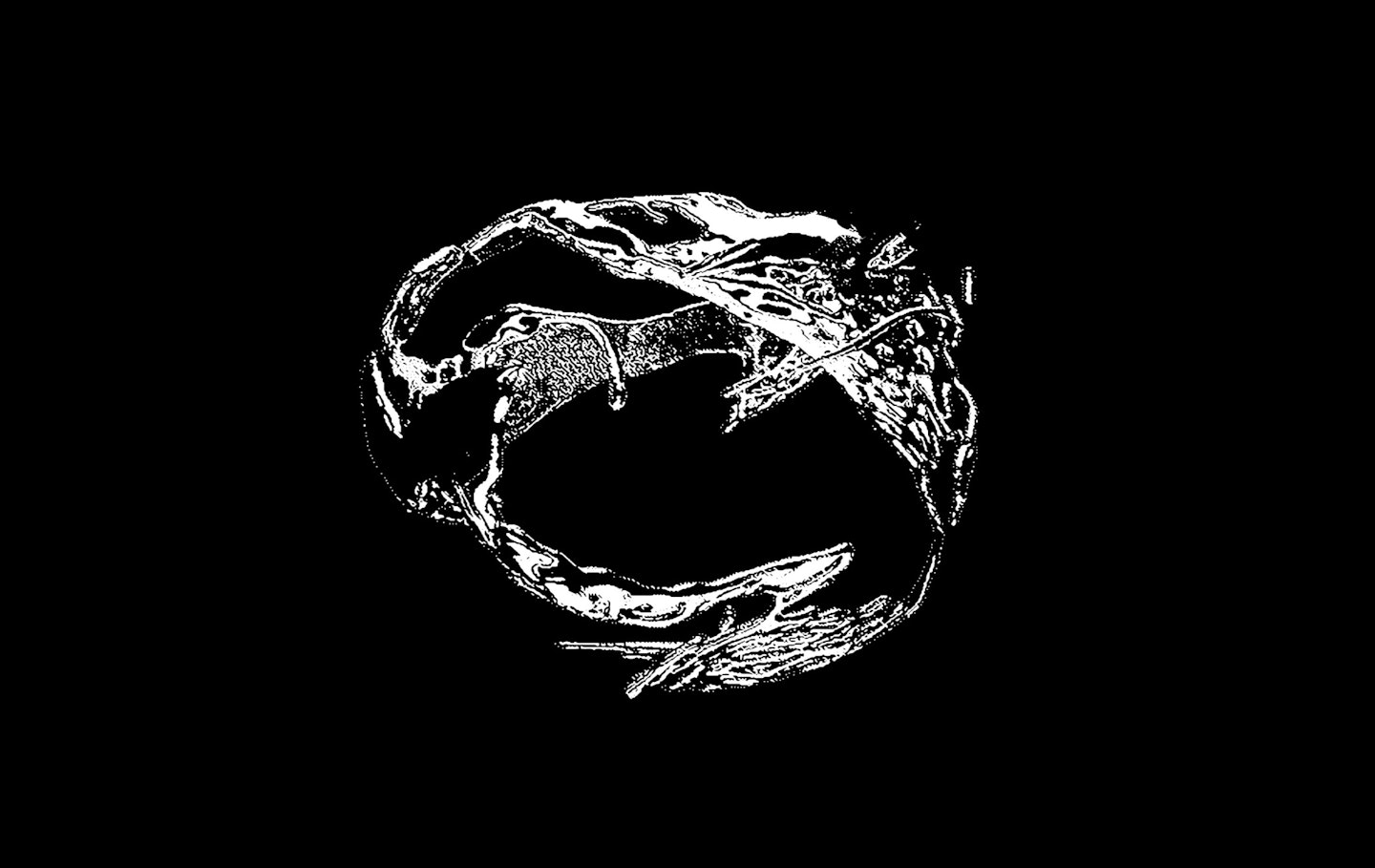
At the limits of visibility are also Lucas Milano's paintings. Their inner landscapes chart spatial principles that reach toward emotional conditions and atmospheric states in still unnamed nebulous zones. Caio Carpinelli's paintings invert the gaze: black surfaces composed of dense layers of paint absorb all around them and return an abyssal geometry. Like a metaphysical enclosure, the painting offers a dynamic perspective constructed through minimal gestures traced in emptiness and silence. Lines appear and eclipse as we approach the canvases, so that the same painting can never be seen twice. This spectral quality is pursued by Leticia Ramos in photography. By combining studies of photographic technique with experiments on the faculties of vision, the artist constructs visualities for transient phenomena, underscoring the drama that settles between what we recognize and what evades us, and the links between the real and the imagined. In Henrique Pavão's work, the investigation into the constitution of the image takes on an extreme character. The artist performs a literal alchemy by creating a sculpture made from silver extracted from kilometers of 35 mm film in the laboratories of the Portuguese Cinematheque. It is the ghostly matter of cinema crystallized into a metallic body that holds within it the memory of everything that light imprinted onto those films. With its circular shape—emulating the drum of the extraction machine—and its imprecise texture, the piece becomes an icon, both conceptual and physical, of this process of transfiguration.
The trajectory flows into the body. Iara Izidoro's photoperformance brings the synesthetic moment in which the touch of a metallic surface causes her figure to merge with its distorted, ghostly reflection. The scene evokes the capture of a moment of enchantment, as if opening a portal between skin and the exterior. João Pimenta Gomes creates sound installations that reverberate through physical objects: a black column at the center of the space and the floor of the room itself. Though immaterial, the sounds fill the space and make it tremble, like a chorus of entities whispering frequencies. Vera Mota, in turn, investigates the tension between the economy of gesture and the performativity of matter through unnameable presences. In her iron sculpture, a movement suspended between density and lightness affirms the body as an agent; in the columns of basalt fiber—mineral melted and solidified into ultra-fine crystals—it is the substance itself that performs, unraveling as it falls, like uncanny cascades of hair.
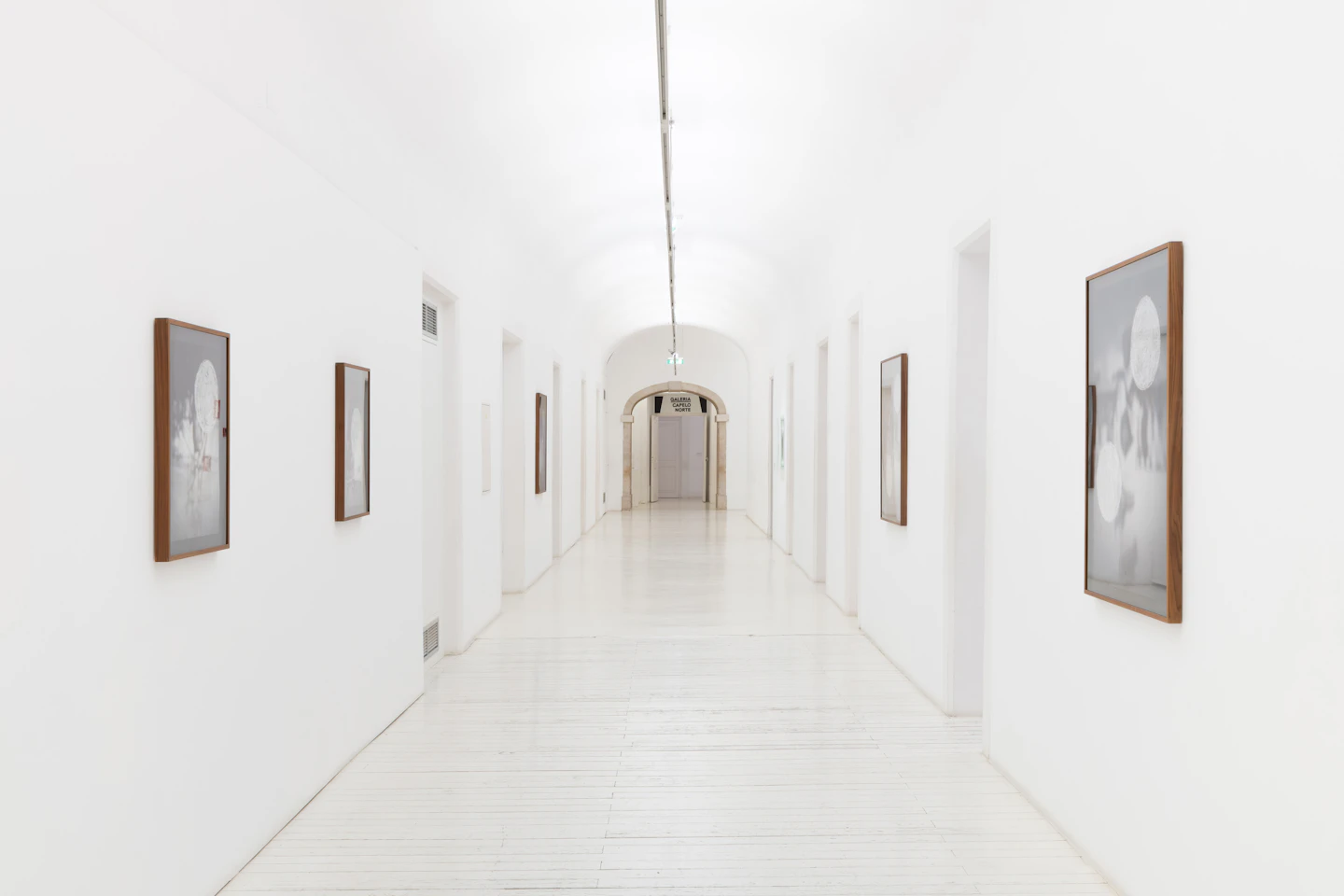
Finally, Paulo Nazareth's work summons historical ghosts in the series white ethnography. The artist intervenes upon photographs appropriated from colonial ethnographic archives, enlarging and blurring them so that the original documentation gives way to specters and enigmas. He then inscribes circles of efun on the surface—white chalk sacred in Yoruba culture and Afro-diasporic religions, used in ritual practices. This gesture turns these images from mere classificatory records into bearers of their violent legacy and its possible transformation. The white circle here is not that of geometric universalism, but the invocation of a primordial act that wards off death. The intervention becomes an attempt to overcome the shadow of a dire past and restore to these bodies the luminosity they once emanated.
The exhibition space actively participates in the experience. The long corridor punctuated by lateral chambers imposes a processional path through a liminal space—one advances as if through a tunnel, unveiling events that follow one another and intensify from room to room. The alternation between settings gives the route a psychological character, like a passage through different mental states. Amid shadowy figures, auras, minimal forms, and enigmatic sounds, what is at stake is not what is seen or heard, but how what is intuited, what is felt, makes itself present.